What Is Carpet Area BuiltUp Area and Super BuiltUp Area
13 August 2025|9 Minutes Read
By : Admin

What is Carpet Area, Built-Up Area and Super Built-Up Area

Understanding the fundamental differences between carpet area, built-up area, and super built-up area is essential for every prospective homebuyer and real estate investor. These three measurement terminologies determine not only the actual usable space you receive but also significantly impact the property’s pricing structure. With the implementation of the Real Estate (Regulation and Development) Act 2016 (RERA), transparency in area calculations has become mandatory, making it crucial for buyers to comprehend these concepts thoroughly.

What is Carpet Area?

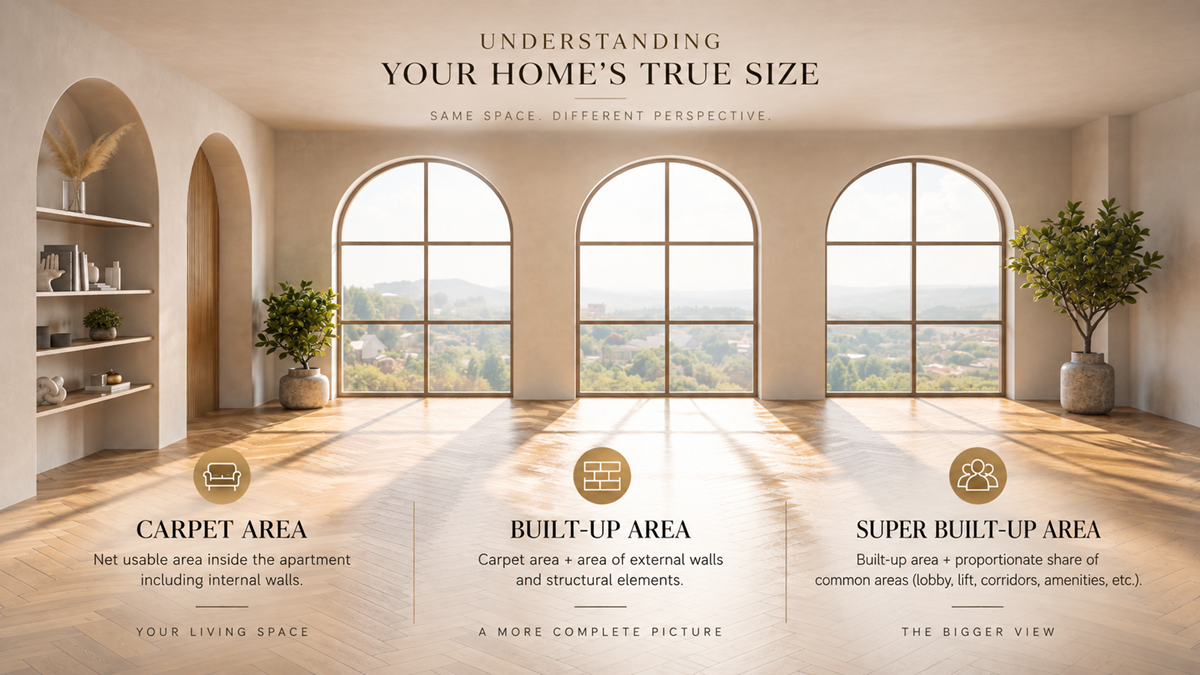
Carpet area represents the most critical measurement for homebuyers as it defines the actual usable floor space within your property. According to RERA guidelines, carpet area is defined as “the net usable floor area of an apartment, excluding the area covered by external walls, areas under service shafts, exclusive balcony or verandah area, and exclusive open terrace area, but includes the area covered by internal partition walls of the apartment”.

In simple terms, the area in the flat or the apartment, which you could cover using a carpet, is the carpet area. Also known as the net usable area, the carpet area is actually that space in your home that can be used for laying a carpet. It includes the thickness of the internal wall but excludes the balcony or terrace. Technically, the distance between the inner walls is the carpet area. Also, it will include a staircase only if it is inside the apartment.

The real estate developers in India widely misused these terms by misinforming buyers about the real usable area and coined complicated terms to give a false sense of a large space. After the Real Estate (Regulation and Development) Act, 2016 (RERA) came into force, it is now mandatory for all builders to sell flats based on the carpet area.

=> Read Also:- What Does RERA Carpet Area Mean and How to Calculate it?

How to Calculate Carpet Area?

Calculating carpet area involves a straightforward process that helps determine your actual living space:

Formula: Carpet Area = (Area of bedroom + living room + kitchen + bathrooms + internal passages) – thickness of internal walls

Step-by-step calculation:

  1. Measure each room individually – Calculate length × width for every usable space
  2. Add all room areas together – Sum the individual areas of all rooms
  3. Subtract internal wall thickness – Deduct the space occupied by walls between rooms
carpet area

Example Calculation:

  • Living & Dining Room: 22 ft × 18 ft = 396 sq ft
  • Master Bedroom: 20 ft × 14 ft = 280 sq ft
  • Second Bedroom: 18 ft × 12 ft = 216 sq ft
  • Kitchen: 10 ft × 9 ft = 90 sq ft
  • Total Carpet Area: 396 + 280 + 216 + 90 = 982 sq ft

Importance of Carpet Area in Property Transactions

Understanding carpet area is crucial for several reasons that directly impact your investment decision:

Transparent Pricing Structure: RERA mandates that builders must quote property prices based solely on carpet area, eliminating misleading pricing practices. This ensures you pay only for the space you can actually use.

Accurate Space Assessment: Carpet area provides the most realistic picture of your living space, helping you determine if the property meets your lifestyle requirements and furniture placement needs.

Property Comparison: When comparing different properties, carpet area serves as the standardized measurement unit, allowing for fair and accurate comparisons across various developments.

Bank Loan Calculations: Financial institutions primarily consider carpet area for property valuation and loan disbursement, making it critical for your financing arrangements.

What is the Built-Up Area?

Built-up area represents a broader measurement that includes the carpet area along with additional structural components. This measurement provides a comprehensive view of the total constructed space within your apartment unit.

The built-up area includes the carpet area along with the thickness of the walls. It encompasses all enclosed spaces within the apartment, such as rooms, corridors, and balconies. Calculating the built-up area involves considering the internal dimensions and wall thickness.

Components of Built-Up Area

Built-up area encompasses several elements beyond the basic living space:

  • Complete carpet area – All usable floor space within walls
  • Wall thickness – Both internal and external wall areas
  • Balconies and terraces – Covered and uncovered attached spaces
  • Exclusive utility areas – Private service areas within your unit
  • Internal staircases – Private stairs within multi-level units

How to Calculate Built-Up Area?

The calculation for built-up area follows a systematic approach that accounts for all covered spaces:

Formula: Built-up Area = Carpet Area + Wall Areas + Balconies + Terraces + Exclusive Utility Areas

Built-up Area

Practical Example:

  • Carpet Area: 1,000 sq ft
  • Total wall thickness (internal & external): 100 sq ft
  • Balcony area: 50 sq ft
  • Terrace area: 50 sq ft
  • Built-up Area: 1,000 + 100 + 50 + 50 = 1,200 sq ft

Why Built-Up Area Matters

Built-up area serves specific purposes in real estate transactions:

Comprehensive Space Understanding: It provides insight into the total constructed space, helping buyers understand the complete unit size including structural elements.

Construction Cost Assessment: Builders often use built-up area calculations for construction cost estimation and material planning.

Comparative Analysis: When comparing properties with different architectural styles, built-up area helps evaluate the efficiency of space utilization.

=> Read Also:- The Difference Between Carpet Area and Built-Up Area

What is Super Built-Up Area

Super built-up area, also known as saleable area, represents the most comprehensive measurement in real estate transactions. This figure includes your exclusive built-up area plus a proportionate share of all common areas and amenities within the building complex.

The super built-up area extends beyond the built-up area and includes common spaces, amenities, and shared facilities like staircases, lobbies, and gardens. It represents the total area a buyer pays for, including their proportionate share of the common spaces.

How to Calculate Super Built-Up Area?

Here’s a step-by-step guide on how to calculate super built-up area:

Step 1: Find the Carpet Area

Measure the actual usable floor space:

  • Living room: 20 ft × 15 ft = 300 sq ft
  • Master bedroom: 15 ft × 12 ft = 180 sq ft
  • Second bedroom: 12 ft × 10 ft = 120 sq ft
  • Kitchen: 10 ft × 8 ft = 80 sq ft
  • Bathrooms: 6 ft × 6 ft each = 72 sq ft
  • Corridors: 50 sq ft

Total Carpet Area = 300 + 180 + 120 + 80 + 72 + 50 = 802 sq ft

Step 2: Calculate Built-Up Area

Add wall thickness and balcony areas:

  • Carpet Area: 802 sq ft
  • Wall thickness (15% of carpet area): 802 × 0.15 = 120 sq ft
  • Balcony area: 80 sq ft

Built-Up Area = 802 + 120 + 80 = 1,002 sq ft

Step 3: Determine the Loading Factor

The developer tells you the loading factor is 30% (0.30)

Step 4: Apply the Loading Factor

Using the simple formula:
Super Built-Up Area = Carpet Area × (1 + Loading Factor)
Super Built-Up Area = 802 × (1 + 0.30) = 802 × 1.30 = 1,043 sq ft

Step 5: Verify with Quick Check

Loading Factor Check = (1,043 – 802) ÷ 802 × 100 = 30% ✓

Final Result:

  • Carpet Area: 802 sq ft (what you actually live in)
  • Built-Up Area: 1,002 sq ft (includes walls and balcony)
  • Super Built-Up Area: 1,043 sq ft (what you pay for)
  • Loading Factor: 30%

Price Calculation: If the rate is ₹8,000 per sq ft of super built-up area:
Total Cost = 1,043 × ₹8,000 = ₹83,44,000

Importance of super built-up area

Understanding super built-up area is crucial for several financial and practical reasons:

Pricing Implications: Most developers price properties based on super built-up area, making it essential to understand what you’re paying for.

Amenity Access: The common area portion determines your access to shared facilities like gyms, swimming pools, and community halls.

Maintenance Costs: Your proportionate share of common areas affects ongoing maintenance expenses.

Investment Analysis: For rental properties, understanding the super built-up area helps evaluate the cost per square foot of actual usable space.

Difference Between Carpet Area, Built-up Area, and Super Built-up Area

AspectCarpet AreaBuilt-Up AreaSuper Built-Up Area
DefinitionActual usable floor space within the walls where you can lay a carpetCarpet area + wall thickness + balconies + terracesBuilt-up area + proportionate share of common areas and amenities
Also Known AsNet usable area, RERA carpet areaPlinth areaSaleable area
What’s Included– Living rooms
– Bedrooms
– Kitchen
– Bathrooms
– Internal corridors
– Internal partition walls
– Complete carpet area
– Thickness of internal walls
– Thickness of external walls
– Balconies and terraces
– Private utility areas
– Complete built-up area
– Lobby and entrance areas
– Staircases and corridors
– Elevator shafts
– Swimming pool and gym
– Clubhouse facilities
– Security rooms
What’s Excluded– External walls
– Balconies
– Terraces
– Common areas
– Utility ducts
– Common areas
– Shared amenities
– Community facilities
– Open-to-sky pools
– Compound walls
– Open parking
– Parks and gardens
– Underground utilities
Calculation FormulaLength × Width of each usable room, then sum all roomsCarpet Area + Wall Areas + Balconies + TerracesBuilt-up Area + Proportionate Common Area
OR
Carpet Area × (1 + Loading Factor)
Size ComparisonSmallest measurement10-20% larger than carpet area25-60% larger than carpet area
Typical Percentage70-85% of super built-up area80-90% of super built-up area100% (maximum quoted figure)
Legal BasisRERA mandates pricing based on carpet areaUsed for construction planningUsed for final property pricing
Primary UseDetermining actual living spaceUnderstanding total unit structureCalculating total investment and pricing
Bank ValuationBanks primarily consider carpet area for loansMay be considered for construction assessmentUsed for overall property valuation
Maintenance CostsNot applicable for common area maintenanceNot applicable for common area maintenanceBasis for common area maintenance charges
Loading FactorBase measurement (0% loading)Minimal loading factor25-60% loading factor applied
Price CalculationRERA requires pricing on carpet area basisRarely used for pricing post-RERAMost developers still price on this basis
Buyer PriorityHighest priority – represents actual usable spaceUseful for understanding construction qualityImportant for understanding total investment
Example (1000 sq ft carpet)1,000 sq ft1,200 sq ft (20% more)1,400 sq ft (40% loading factor)

Conclusion

Understanding the differences between carpet area, built-up area, and super built-up area is fundamental to making successful real estate investments. Carpet area represents your actual living space and serves as the legal basis for transparent pricing under RERA regulations. Built-up area provides insight into the total constructed space including structural elements, while super built-up area encompasses your share of common facilities and amenities.

The key to successful property evaluation lies in focusing on carpet area for space and pricing analysis, understanding built-up area for construction quality assessment, and evaluating super built-up area for amenity value proposition. With RERA’s mandate for transparent area disclosure, buyers now have the tools necessary to make informed decisions based on accurate measurements rather than misleading marketing figures.

By applying this knowledge systematically and avoiding common evaluation mistakes, you can ensure that your property investment provides genuine value in terms of both usable space and long-term appreciation potential. Remember to always verify area calculations through official RERA documents and demand detailed breakdowns from developers to protect your investment interests.

Ganga Realty, the best real estate company in Gurgaon, exemplifies these best practices through flagship projects like Nandaka Sector 84 and Anantam Sector 85, which offer clear area disclosures, efficient design, and premium amenities—ensuring that buyers receive both transparency and long-term value.

Frequently Asked Questions

Super built-up area incorporates your built-up area plus a proportionate share of common areas (lobbies, corridors, amenities). Developers use this metric to include community facilities in the price, though RERA mandates that the carpet area rate must also be disclosed.

Always compare properties using carpet area for a true apples-to-apples comparison of usable living space. Pricing per carpet-area square foot gives the most accurate value assessment.

Most banks evaluate your loan based on the carpet area, as it represents the actual living space. They may also request built-up area details for collateral valuation, but carpet area remains primary.

RERA mandates that all property pricing must be transparently quoted on a carpet area basis. While built-up and super built-up figures can still be marketed, developers must disclose carpet-area rates and provide detailed area breakdowns.

Carpet area is typically 70–85% of the super built-up area. The exact percentage depends on the loading factor; higher loading factors reduce the proportion of actual usable space.

Typically, covered parking may be included proportionately in the super built-up area, whereas open parking and driveways are usually excluded.

Enquire Now

Recent Posts

How to Pay Property Tax in Gurgaon: A Step-by-Step Guide (Online & Offline)
16 January 2026|6 Minutes Read

How to Pay Property Tax in Gurgaon: A Step-by-Step Guide (Online & Offline)

Paying property tax in Gurgaon is a mandatory civic responsibility for all property owners within the limits of the Municipal Corporation of Gurugram (MCG). The revenue collected through MCG property tax Gurgaon is used for the development of city infrastructure, maintenance of roads, sanitation, street lighting, parks, and other essential public services. Many homeowners and property investors often find the tax payment process confusing. This guide simplifies everything by explaining how to pay property tax in Gurgaon—both online and offline—in a step-by-step manner. For a detailed breakdown of rates and tax slabs, read our guide on MCG property tax in Gurgaon. What is Property Tax in Gurgaon? Gurgaon property tax (also referred to as Gurugram property tax or MCG Gurgaon property tax) is an annual tax levied on residential, commercial, and industrial properties within the city. The amount depends on factors such as: Property type (residential, commercial, industrial, or vacant land) Property size and built-up area Location and zone Usage (self-occupied, rented, or commercial use) For homeowners in premium developments like Nandaka 84 in Sector 84, paying house tax Gurgaon on time is essential not only for legal compliance but also for ensuring well-maintained civic infrastructure around their residences, including roads, drainage, and public amenities. How to Pay Property Tax in Gurgaon Online (Step-by-Step) Whether you own a home in a modern residential complex like Anantam 85 or an independent house, the online MCG portal offers a convenient way to manage your property tax obligations without visiting municipal offices. The easiest and most convenient way to pay MCG property tax Gurgaon is through the official online portal of the Municipal Corporation of Gurugram. Step 1: Visit the Official MCG Website: Go to the official Municipal Corporation of Gurugram website. Step 2: Click on ‘Property Tax’ Section :On the homepage, look for the Property Tax tab and click on it. Step 3: Select ‘Property Tax Bill’: Choose the option labelled “Property Tax Bill” to proceed with your payment. Step 4: Enter Property Details: You will be asked to enter details such as: Property ID Owner Name Zone and Ward Locality and Address Make sure all details are correct before proceeding. Step 5: Verify and Search: Click on Search to retrieve your property tax record. Step 6: Check Your Tax Amount: Your Gurugram house tax or property tax amount will be displayed on the screen. Step 7: Choose Payment Method : Select your preferred payment option: Debit Card Credit Card Net Banking UPI Step 8: Complete Payment: Follow the payment gateway instructions and complete the transaction securely. Step 9: Download Receipt: Once the payment is successful, download and save the receipt. This serves as proof of your Gurgaon MCG property tax payment. Tip: Always double-check your property details before final submission to avoid discrepancies. How to Pay Property Tax in Gurgaon Offline If you are not comfortable with online payments, you can pay property tax Gurgaon offline using the following steps: Step 1: Visit MCG Office or Collection Centre: Go to the nearest Municipal Corporation of Gurugram office or authorized tax collection centre. Step 2: Provide Property Details: Submit your: Property ID Owner’s name Address Step 3: Make Payment: Pay your MCG Gurgaon property tax using cash, debit card, or credit card. Step 4: Collect Receipt: Ensure you receive an official payment receipt as proof. Alternatively, certain authorized bank branches in Gurugram also accept MCG property tax payments after verifying property details. To understand how your tax is calculated, refer to our detailed guide on MCG property tax in Gurgaon. Penalty for Late Payment of Property Tax in Gurgaon Failing to pay Gurgaon property tax on time can lead to financial penalties: 1.5% interest per month on the outstanding amount Additional fines may apply in cases of misreporting or tax evasion To avoid extra charges, it is advisable to pay your house tax Gurgaon before the due date. Property Tax Rebates in Gurgaon MCG provides exemptions and rebates on Gurugram property tax for certain categories, including: Small flats in housing societies Self-occupied residential properties Properties in Lal Dora areas If you are eligible, you can significantly reduce your MCG property tax Gurgaon liability. Why Timely Payment of Property Tax is Important Paying property tax in Gurgaon on time ensures: Better civic amenities Improved sanitation and waste management Well-maintained roads and street lighting Legal compliance and peace of mind Your contribution through Gurgaon MCG property tax directly supports city development and public welfare. Your property tax directly supports smart city development in Gurgaon, improving roads, sanitation, and public infrastructure. For homeowners in nature-integrated developments like Ganga Valley 78, timely payment of Gurgaon MCG property tax contributes directly to cleaner surroundings, better landscaping, and improved civic services in and around their community — aligning with the vision of sustainable and eco-conscious living. How Ganga Realty Can Help with Property Tax Payment At Ganga Realty, we assist homeowners and investors with: Understanding their property tax calculation Navigating the online payment process Checking eligibility for rebates and exemptions Ensuring compliance to avoid penalties Maintaining accurate records and documentation If you need help with MCG Gurgaon property tax, our team can guide you every step of the way. For residents enjoying luxury living in Gurgaon, timely property tax payment is just as important as choosing the right home. Whether you live in a smart modern residence like Ganga Kashi Residencies in sector 90, a luxury development like Nandaka 84, a visionary community like Anantam 85, or a nature-focused project like Ganga Valley 78, our team ensures that your MCG Gurgaon property tax process remains smooth, transparent, and hassle-free. Final Thoughts Knowing how to pay property tax in Gurgaon makes the process simple, transparent, and hassle-free. Whether you choose to pay online or offline, staying informed and compliant helps you avoid penalties while contributing to the city’s growth. Choosing a reliable real estate partner like Ganga Realty further adds value to this process. Beyond helping you find the right property, Ganga Realty ensures that homeowners remain well-informed about tax obligations, rebate opportunities, and compliance requirements. Our expertise in property documentation and legal procedures provides added security and convenience to property owners. FAQs – (Property Tax in Gurgaon)

Read More
Vastu vs Modern Architecture: The Surprising Way They Can Coexist
15 January 2026|5 Minutes Read

Vastu vs Modern Architecture: The Surprising Way They Can Coexist

As Indian cities grow taller, denser, and smarter, homebuyers are asking a new question:Can traditional Vastu principles coexist with modern architecture? On one hand, buyers want open layouts, floor-to-ceiling windows, smart home systems, and contemporary aesthetics. On the other hand, many still care deeply about orientation, natural flow, balance, and well-being — all central ideas in Vastu Shastra. So, is it a conflict? Or is it actually a design opportunity? Let’s explore how Vastu vs Modern Architecture is no longer a debate — but instead, a blend that defines the future of Indian housing. What Is Vastu Shastra — In a Modern Context? Vastu Shastra is often misunderstood as rigid rules or superstition. However, in reality, it is an ancient system of spatial planning based on: Sunlight orientation Airflow and ventilation Functional zoning of spaces Human comfort and psychological balance In other words, Vastu is less about rituals and more about design logic. Traditionally, Indian spatial planning focused heavily on climate-responsive design, orientation, and ventilation — principles also reflected in government-backed building guidelines from institutions like the Central Public Works Department of India. For example, east and north orientations maximise natural light. Similarly, proper zoning separates noisy, active spaces from quiet, restful ones. As a result, balanced layouts improve comfort and reduce stress. Vastu Shastra is often misunderstood; however, when applied thoughtfully, it helps improve natural light, airflow, and comfort — as explained in our guide on choosing the best facing house as per Vastu. What Defines Modern Architecture Today? Modern architecture prioritises: Clean, minimal design Open floor plans Large windows and natural light Sustainable materials Smart home technology Efficient space usage Moreover, urban architecture must now respond to high-rise living, limited land availability, environmental responsibility, and the lifestyle expectations of younger buyers. Therefore, architecture has become more functional, more sustainable, and more human-centric. Interestingly, these priorities are not very different from Vastu’s core ideas. Why Are Vastu and Modern Architecture Seen as Conflicting? Many people assume they conflict because Vastu is seen as traditional and restrictive, whereas modern architecture is seen as free-form and design-driven. However, this is a surface-level perception. In reality, the conflict arises when Vastu is applied rigidly, without considering urban constraints — or when architecture ignores human comfort in favour of pure aesthetics. Therefore, the problem is not Vastu or modern design — it is how they are interpreted. How Vastu and Modern Architecture Actually Complement Each Other When interpreted intelligently, they complement beautifully. Vastu PrincipleModern EquivalentNatural light orientationEnergy-efficient daylight planningCross ventilationPassive cooling designBalanced zoningFunctional space planningHarmony with natureBiophilic and sustainable design Therefore, instead of opposing forces, they are two perspectives aiming for the same outcome — better living. How Vastu Fits into Apartments and High-Rise Living Many people believe Vastu is only relevant for independent houses. However, that is no longer true. In fact, in modern apartments: Entry direction can be optimised Kitchen and bedroom placement can follow zoning logic Light and ventilation can align with Vastu principles Small layout adjustments can enhance energy flow For example, in luxury high-rise projects, architects often integrate east-facing living areas, central green spaces, and balanced floor plate planning. In fact, many luxury residential projects in Gurgaon are now designed with balanced layouts, abundant natural light, and green spaces that reflect both Vastu principles and contemporary design. Sustainability — The Shared Foundation Perhaps the strongest bridge between Vastu and modern architecture is sustainability. Notably, both promote efficient energy usage, respect for natural elements, reduced dependency on artificial systems, and better thermal comfort. As a result, Vastu becomes a philosophical layer over green architecture — not a competitor. Moreover, this philosophy aligns closely with the idea of smart city development in Gurgaon, where sustainability and livability shape modern urban planning. Buyer Checklist: Choosing a Vastu-Friendly Modern Home When evaluating a property, consider the following: Good natural light and airflow Logical room zoning Quiet bedroom placement Minimal structural obstructions Open yet balanced layouts Therefore, before finalising a home, buyers should also refer to our residential property buyer’s guide for Gurgaon to understand market trends and long-term value. The Future: Integrated Design Is the New Luxury Today’s luxury is not just marble floors or tall towers. Rather, it is comfort, well-being, sustainability, and emotional satisfaction. Therefore, the future belongs to homes that combine traditional spatial wisdom with modern technology and design. Ultimately, developers who understand this shift are creating spaces that feel good to live in — not just impressive to look at. Conclusion In summary, the question is no longer Vastu vs Modern Architecture. Rather, the real question is how well they are integrated. When tradition informs design and design respects human comfort, homes become more than structures — they become spaces that support better living. That is the true future of Indian real estate. At Ganga Realty, we believe that thoughtful design creates better living — which is why our premium residential communities in Gurgaon focus on harmony, sustainability, and modern comfort. FAQs (People Also Ask)

Read More
--> -->