Real estate investment insights 2025
27 May 2025|8 Minutes Read
By : Ganga Realty

Commercial Real Estate Investment: Trends, Risks & Opportunities

India’s commercial real estate sector has moved well past its early-growth phase. What was once considered a niche, institution-only asset class is now a mainstream part of serious investment portfolios — office space, retail high streets, warehousing and flexible workspace are all seeing sustained demand from both domestic and global capital.

Whether you’re an institutional investor looking for secure rental returns or someone looking to buy commercial space in Gurgaon, the commercial property sector is full of potential — even if it has its own share of problems. Staying in touch with new trends, understanding the risks, and staying tuned to the market’s pulse are all crucial if you’re going to make smart decisions.

Why Commercial Real Estate is Gaining Traction in India

Commercial property’s core appeal hasn’t changed: a stable income stream that residential units rarely match. Grade-A office and pre-leased retail assets in Gurugram now typically deliver rental yields of 6-11%, against 2-3% for residential — a gap that has only widened as institutional capital has poured in.

What has changed is the depth of the market. India’s Global Capability Centre (GCC) boom has become the single biggest demand driver for Grade-A office space, with GCCs accounting for roughly 40-50% of all Grade-A leasing through 2026, alongside continued expansion from IT/ITeS, BFSI, engineering and flexible workspace operators.

Real Estate Market Analysis India: 2026 & Beyond

India’s commercial real estate market is on a structural growth path — industry estimates put it expanding from roughly ₹26.4 lakh crore in 2025 to as much as ₹88 lakh crore by 2030. The office segment alone delivered its strongest year on record in 2025, with net absorption of 61.4 million sq ft (up 25% YoY) and total leasing of 82.6 million sq ft.

That momentum has carried into 2026: the top eight cities recorded 21.9 million sq ft of gross leasing in Q1 2026 alone, up 13% year-on-year, and pan-India weighted average office rents crossed ₹100 per sq ft per month for the first time.

Institutional capital is validating this growth. Capital inflows into Indian real estate hit US$5.1 billion in Q1 2026, up 72% year-on-year, and 2025 closed with a record US$10.5 billion in institutional real estate investment for the full year — most of it now domestic-led, through private equity and REITs rather than purely foreign capital.

Top Trends in Commercial Real Estate Investment in India

A few forces are shaping where capital is headed next:

  • Tier-II cities (Indore, Jaipur, Coimbatore, Kochi) continue to draw early-mover capital on the back of lower entry costs and improving infrastructure, though Tier-I markets still command the bulk of institutional volume.
  • Flexible workspaces are now core infrastructure, not an experiment — flex operators alone accounted for roughly 18-22% of total Grade-A leasing through 2026, and landlords are underwriting flex-ready buildings from day one.
  • Green-certified, IoT-enabled “smart” buildings command a rental premium — LEED Platinum or GRIHA-rated assets are fetching around 15% higher rents, largely because large occupiers (especially GCCs) now mandate green-building compliance.
  • Logistics and warehousing are the fastest-growing commercial sub-segment, projected at an 18.6% CAGR through 2031 as e-commerce and quick-commerce operators sign long-duration leases for large-format space.

Why Gurgaon is a Hotspot for Commercial Property

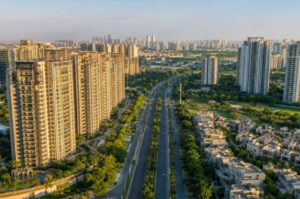
Gurugram’s case as North India’s commercial capital has only strengthened. It remains home to 250+ Fortune 500 companies, sits minutes from IGI Airport via NH-48, and continues to record the highest commercial absorption in the NCR.

Pricing and yields now vary sharply by corridor, which is exactly why location selection matters more than ever:

New Gurgaon (Sectors 82-115): the fastest-growing catchment on the back of residential density, with commercial rentals still meaningfully below the Golf Course Road benchmark.

Golf Course Road / Golf Course Extension Road: ₹18,500-₹34,000 per sq ft, with yields around 8-8.5% in the premium “new Wall Street” stretch (Sectors 61-67).

Dwarka Expressway: ₹11,000-₹20,000 per sq ft, appreciating 15-20% annually since becoming fully operational — the current hotspot for SCO (Shop-cum-Office) plots, with some pre-rented SCO assets touching 11%+ yields.

Sohna Road / Sohna: lower entry pricing than Delhi-NCR’s saturated core, strong connectivity via the extended Rapid Metro and IMT Sohna, and rising visibility as an organised retail and mixed-use destination — this is the corridor where Ganga Realty’s own Swarnim High Street sits.

Also Read: Commercial vs Residential Real Estate

Emerging Micro-Market: Sohna

Sohna deserves a category of its own. What was a peripheral business district a few years ago is now one of NCR’s more discussed emerging commercial corridors — driven by the Rapid Metro extension, IMT Sohna’s industrial base, and its position as a lower-cost alternative to Gurugram’s saturated core.

For investors priced out of Golf Course Road but unwilling to trade down on long-term growth potential, Sohna’s combination of affordable entry pricing and improving infrastructure makes it one of the more compelling under-the-radar plays in the NCR commercial story — and it’s precisely this thesis that underpins Swarnim High Street, Ganga Realty’s commercial development in Sohna Sector 5.

Risks Involved in Commercial Real Estate Investments

No investment is risk-free — and neither is commercial property.

High Initial Cost

Commercial properties carry a materially higher entry ticket than residential units. The trade-off is higher yield, but it does raise the bar for first-time investors and makes financing structure and holding period especially important to plan upfront.

Market Cycles and Vacancy Risks

Commercial demand is more cyclical than residential. A slowdown can widen vacancies and compress rentals faster than in housing, which is why tenant credit quality, lease tenure, and location resilience matter more here than almost any other underwriting factor.

Liquidity Constraints

Exiting a commercial asset takes longer than a residential one, and liquidity is heavily concentrated in prime corridors. Secondary or peripheral locations can see holding periods stretch well beyond an investor’s original plan.

Extensive due diligence, a credible broker, and a time horizon matched to the asset class remain the best mitigants against all three.

Office Space vs Retail: Which One Should You Choose?

Between retail property and office space, the decision largely relies on your investment goals. Office spaces will provide stability and long-term returns. Leases are typically for a term of a few years, so it is easier to forecast rental income. In places like Gurgaon, where corporate office space demand is high, investing in office space can be a sure bet.

Shopping centers, nonetheless, can achieve higher rents, particularly if they are high-traffic areas. A situated store rented out to a high-end brand can obtain premium rents. The risk is greater, though. Retail companies are more susceptible to economic downturns, trends, and flows of shoppers, which can contribute to higher levels of vacancy when business is down.

The right choice depends on risk appetite. Office space offers longer, more predictable lease terms and is currently the more institutionally favoured bet given the GCC-led demand wave — it still represents roughly half of India’s total commercial real estate market.

Retail can deliver higher rents in high-footfall locations, but is more exposed to consumption cycles and shopping-pattern shifts. Risk-averse investors typically lean office; those comfortable riding demand cycles for a higher ceiling lean retail.

Also Read: Gurugram Real Estate Investment: Key Factors, Opportunities & Challenges

Who Should Invest in Commercial Real Estate?

Commercial real estate is no longer gated behind institutional-size cheques. India’s listed REIT market has crossed ₹1,00,000 crore in market capitalisation and is projected to grow into a ₹10,80,000 crore opportunity by 2029, giving individual investors a listed, liquid route into office and retail assets without buying property directly.

SEBI’s January 2026 move to reclassify mutual fund REIT holdings as equity instruments has further opened the door for broader retail participation, alongside the continued rise of fractional-ownership platforms for smaller-ticket direct exposure.

For investors seeking passive income, portfolio diversification, and a partial inflation hedge, commercial property — held directly or through REITs — remains one of the more resilient asset classes in the current cycle, provided it’s approached with the right research and time horizon.

Also Read: The High-street Redefining Retail Spaces in India

Conclusion

Ganga Realty, a leading real estate developer in Gurgaon, knows that the Indian commercial real estate market is rich in potentiality — as well as in need of discrimination. From an office block in Gurgaon to high-street retail space or a unit in a REIT, opportunities for investment in Commercial Property in Gurgaon and beyond have never been greater.

With the right location, the right lease structure, and expert guidance, 2026 remains a strong entry point into India’s commercial real estate story. If you’re evaluating Commercial Properties in Gurgaon, the market’s institutional momentum suggests the window for favourable entry pricing continues to narrow.

If you are ready to invest in Commercial properties in Gurgaon, the time is now. Acumen investors have already placed their bets on the Indian commercial skyline. Are you?

FAQs About Commercial Real Estate

Yes. Gurgaon offers robust infrastructure, a corporate-friendly ecosystem, and consistent demand for office and retail spaces — making it a safe and high-potential zone for investors.

With REITs, shared ownership models, and mid-sized projects, even individual investors can participate in commercial real estate today.

Look into location, connectivity, tenant profile, property grade (A, B, or C), lease terms, and future development plans in the vicinity.

DLF Cyber City, Golf Course Road, MG Road, Sohna Road, and emerging sectors like 84, 85, and 88A are promising for long-term commercial investments.

Enquire Now

Recent Posts

MIVAN Construction Technology: How It Works, Benefits, Advantages, Limitations & Future
10 September 2026|12 Minutes Read

MIVAN Construction Technology: How It Works, Benefits, Advantages, Limitations & Future

The real estate and construction industry is rapidly evolving with the adoption of advanced technologies that improve construction speed, quality, consistency, and efficiency. One such technology that has gained significant attention in modern residential and high-rise construction is MIVAN Construction Technology. MIVAN is an aluminium formwork system designed to create structural components such as walls, slabs, columns, beams, and other elements with greater speed and dimensional accuracy. Unlike conventional construction methods that often rely heavily on brickwork, timber formwork, and manual processes, MIVAN construction uses a systematic aluminium formwork system to create reinforced concrete structures. As urban development becomes increasingly focused on faster project delivery, consistent construction quality, efficient space utilization, and durable structures, technologies such as MIVAN are becoming increasingly relevant. For homebuyers, understanding construction technology is also important because the construction method can influence factors such as structural consistency, finishing quality, project timelines, and long-term performance. In this guide, we will explore what MIVAN construction technology is and how this formwork works. What Is MIVAN Construction Technology? MIVAN Construction Technology is a modern construction method that uses specially designed aluminium formwork to create reinforced concrete structures. The MIVAN system consists of lightweight, reusable aluminium panels that are assembled according to the required dimensions of the building. Concrete is then poured into these forms to create structural elements such as: Reinforced concrete walls Floor slabs Columns Beams Staircases Other structural components Once the concrete achieves the required strength, the aluminium panels are removed and reused for the next construction cycle. The key difference between MIVAN and conventional construction is the level of standardization and repetition involved in the construction process. Traditional construction often involves multiple stages and materials, including masonry walls, plastering, shuttering, and manual finishing. MIVAN construction integrates several structural elements into a systematic reinforced concrete construction process. What Is MIVAN Formwork? MIVAN formwork is essentially a reusable aluminium moulding system used to shape concrete. The panels are manufactured with high dimensional accuracy and assembled on-site to form the required structure. Because the panels can be reused repeatedly, the system is particularly suitable for projects involving multiple floors or repetitive apartment layouts. This makes MIVAN aluminium formwork especially useful in large-scale residential developments and high-rise buildings. How MIVAN Construction Works The MIVAN construction process follows a systematic sequence. While exact construction practices vary depending on the project, the general process involves several key stages. Step 1: Structural Planning Before construction begins, detailed structural and architectural drawings are prepared. The dimensions of walls, slabs, openings, staircases, and other structural components must be carefully coordinated because the aluminium formwork is manufactured according to the required specifications. Step 2: Formwork Assembly The aluminium panels are brought to the construction site and assembled according to the building design. Workers connect the panels using specially designed components and supporting systems. Because the system is standardized, the assembly process can be repeated across different floors. Step 3: Reinforcement Placement Steel reinforcement is installed inside the formwork. The reinforcement provides the necessary tensile strength to the reinforced concrete structure and is positioned according to the structural design. Step 4: MEP Coordination Mechanical, electrical, and plumbing elements are coordinated before concrete is poured. Electrical conduits, plumbing sleeves, openings, and other embedded services need to be accurately positioned within the formwork. Step 5: Concrete Pouring Concrete is poured into the assembled aluminium formwork. The concrete fills the spaces created by the panels, forming walls, slabs, beams, and other structural components. Step 6: Concrete Curing After pouring, the concrete is allowed to gain sufficient strength through the appropriate curing process. The required curing period and procedures depend on the concrete mix, environmental conditions, structural requirements, and project specifications. Step 7: Formwork Removal Once the concrete reaches the required strength, the aluminium panels are carefully removed. The panels can then be cleaned, inspected, and reused for the next construction cycle. This repetitive cycle is one of the major reasons why MIVAN construction can achieve faster construction timelines in suitable projects. Why MIVAN Is Essential for Modern Construction The construction industry is under constant pressure to deliver projects faster without compromising quality. Large residential developments often involve hundreds or even thousands of repetitive units. Conventional construction processes can become increasingly complex when applied at such a scale. This is where MIVAN technology can offer significant advantages. Faster Construction Cycles: Because the formwork system is designed for repetitive construction, teams can complete similar structural sections in relatively short cycles. This can help developers manage large-scale projects more efficiently. Consistent Construction Quality: Factory-manufactured aluminium panels provide standardized dimensions. When properly designed and installed, this can reduce variations in structural dimensions across repeated construction cycles. Reduced Dependence on Traditional Shuttering: MIVAN uses aluminium panels rather than conventional timber-based shuttering systems. The panels are designed specifically for repeated use, making them suitable for projects with a large number of similar units. Better Construction Planning: MIVAN construction requires detailed planning before work begins. This encourages greater coordination between structural, architectural, electrical, and plumbing teams. For modern developers such as Ganga Realty, where large-scale residential development requires careful coordination of design, engineering, execution, and customer expectations, construction systems that support standardized processes can play an important role in project execution. MIVAN vs Conventional Construction One of the most common questions is: How is MIVAN construction different from conventional construction? The primary difference lies in the formwork system and the way structural components are constructed. FeatureMIVAN ConstructionConventional ConstructionFormworkAluminium formworkTraditional shuttering/formworkConstruction ProcessHighly systematicRelatively flexibleRepetitionHighly suitableSuitable but often more labour-intensiveDimensional AccuracyGenerally high with proper executionDepends significantly on workmanshipConstruction SpeedFaster for repetitive designsUsually slower for similar large-scale repetitionReusabilityAluminium panels are reusableDepends on formwork materialFinishingCan provide relatively smooth concrete surfacesOften requires additional finishingInitial PlanningRequires detailed planningComparatively flexibleDesign FlexibilityLess flexible after formwork is fabricatedGreater flexibility during executionIdeal ApplicationHigh-rise and repetitive developmentsVaried building types and customized projects It is important to understand that MIVAN is not automatically better for every construction project. Its effectiveness depends on the building design, repetition, project scale, planning quality, contractor expertise, and execution standards. Advantages of MIVAN Construction MIVAN construction has become popular because it offers several benefits for large-scale and repetitive construction projects. Faster Construction: One of the biggest advantages of MIVAN technology is its potential to accelerate construction cycles. Once the formwork system is established, the same sequence can be repeated floor after floor. This makes it particularly useful for high-rise residential projects where construction speed is an important consideration. High Dimensional Accuracy: The aluminium panels are manufactured according to specific measurements. This can help achieve consistent dimensions across structural elements when the system is properly designed and executed. Better Surface Finish: Concrete poured into well-maintained aluminium formwork can produce relatively smooth surfaces. This may reduce the requirement for extensive plastering in certain applications, although finishing requirements depend on the project specifications and desired final finish. Reusable Formwork: Aluminium MIVAN panels are designed to be reused. For projects involving repetitive floor plans, the same formwork components can be used multiple times. This makes the system more efficient when deployed at an appropriate scale. Reduced Construction Waste: A systematic formwork system can help reduce certain types of construction waste associated with traditional shuttering materials. Better planning and controlled material usage can contribute to more efficient construction practices. Improved Construction Consistency: Because the same formwork configuration can be repeatedly used, similar units can be constructed with greater consistency. For residential developments, consistency can be particularly valuable when multiple apartments follow similar structural layouts. Better Integration of Construction Activities: MIVAN construction requires structural, electrical, plumbing, and architectural teams to coordinate early. This can improve workflow planning and reduce avoidable rework when the project is managed effectively. Suitable for High-Rise Development: High-rise residential apartments construction often involves repetitive floor layouts. MIVAN formwork can be particularly effective in such environments because the same system can be repeated across multiple floors. Limitations of MIVAN Technology Despite its advantages, MIVAN construction is not without limitations. Understanding these limitations is important when evaluating any modern construction technology. High Initial Investment: Aluminium formwork systems require significant initial planning, design, manufacturing, and procurement investment. This can make MIVAN less attractive for small or highly customized projects. Limited Design Flexibility: Once aluminium formwork has been manufactured for a specific configuration, making major design changes can be difficult. Therefore, MIVAN projects require detailed design coordination before construction begins. Requires Skilled Workforce: Although the system is standardized, workers need proper training and experience to assemble, align, remove, and maintain the formwork correctly. Poor installation can negatively affect construction quality. Transportation and Storage: The formwork panels need to be transported, organized, cleaned, and stored properly. Effective site management is therefore essential. Less Suitable for Highly Customized Buildings: Buildings with highly irregular designs, frequent changes in dimensions, or unique architectural elements may not benefit from MIVAN to the same extent as repetitive structures. Early Planning Is Critical: One of MIVAN's strengths—standardization—is also one of its biggest requirements. Design changes made late in the process can create complications because the formwork system has already been designed around specific dimensions. Where MIVAN Works Best MIVAN construction technology is particularly effective when a project has a high degree of repetition. Some common applications include: High-Rise Residential Buildings: Apartment towers often have repetitive floor layouts, making them a strong application for aluminium formwork systems. Large Residential Communities: Large housing developments containing multiple similar units can benefit from standardized construction processes. Affordable and Mass Housing: Projects where speed, consistency, and scalability are important can potentially benefit from MIVAN construction. Repetitive Commercial Structures: Certain commercial developments with standardized structural layouts can also use aluminium formwork. Large-Scale Urban Development: As cities expand vertically, construction technologies that support faster and more predictable project execution are becoming increasingly relevant. For a modern real estate developer such as Ganga Realty, the broader lesson is that construction technology is not simply about building faster. It is about creating a coordinated construction ecosystem where design, engineering, materials, workmanship, quality control, and project management work together. Choosing a MIVAN Formwork System Selecting the right MIVAN formwork system requires more than simply comparing aluminium panels. Developers and contractors should evaluate several factors. Project Scale: MIVAN becomes increasingly practical when the project involves significant repetition. The larger the number of similar structural cycles, the greater the potential efficiency. Building Design: The architectural and structural design should be evaluated for compatibility with aluminium formwork. Highly irregular designs may require more customization. Formwork Quality: The quality and dimensional accuracy of aluminium panels directly influence the construction process. Contractor Experience: Experienced teams can assemble and dismantle the system more efficiently while maintaining required standards. Engineering Coordination: Structural, architectural, electrical, plumbing, and other services must be coordinated before formwork production and construction. Construction Schedule: The technology should be evaluated based on the project's overall construction strategy rather than speed alone. Quality Control: Regular inspection of reinforcement, formwork alignment, concrete placement, curing, and stripping procedures remains essential. Ultimately, the best construction technology is one that matches the project's design, scale, quality requirements, budget, and execution capabilities. The Future of MIVAN Construction The future of construction is increasingly moving toward industrialized, standardized, technology-driven, and data-led construction processes. MIVAN construction is part of this broader transformation. As developers seek better construction productivity and more predictable project execution, aluminium formwork can continue to have an important role, particularly in large-scale residential development. However, the future is unlikely to depend on one technology alone. MIVAN can increasingly work alongside other construction innovations such as: Building Information Modelling (BIM) Digital project management Prefabrication Modular construction Automated quality inspections Drone-based site monitoring Advanced concrete technologies Construction analytics Sustainable building materials The combination of these technologies can create a more integrated construction ecosystem. For homebuyers evaluating residential developments, understanding construction methodologies can provide valuable context when comparing projects. Developers such as Ganga Realty operate in a market where buyers increasingly look beyond location and amenities to understand construction quality, design, specifications and long-term value. Buyers exploring modern residential developments can also learn more about, its specifications, location advantages, amenities and development approach. Anantam 85 Ultra-luxury residences on Dwarka Expressway offering expansive green spaces and world-class amenities. View Project Nandaka 84 Modern residential community in New Gurgaon designed for connectivity, comfort, and lifestyle. View Project Ganga Kashi Residences Premium residential development offering peaceful living with contemporary amenities. View Project Ganga Valley 78 Integrated township living with lush green spaces and a complete lifestyle ecosystem. View Project Conclusion MIVAN Construction Technology is transforming the way large-scale residential and high-rise buildings are constructed. By using reusable aluminium formwork, the system enables a more structured construction process with greater consistency, faster construction cycles, and improved dimensional accuracy. As the real estate industry continues to adopt smarter construction methods, developers such as Ganga Realty are part of a broader shift toward more efficient, technology-driven, and quality-focused residential development. Ultimately, the future of construction is not just about building faster—it is about building better, smarter, and with greater consistency for the people who will call these spaces home. FAQs About MIVAN Construction Technology

Read More
Golf Course Extension Road: Why It Remains Gurugram’s Premium Address
27 August 2026|12 Minutes Read

Golf Course Extension Road: Why It Remains Gurugram’s Premium Address

Gurugram has transformed from a corporate satellite city into one of India’s most influential real estate destinations. Within this rapidly evolving landscape, Golf Course Extension Road continues to stand apart as a premium residential and investment address. Often referred to as Golf Course Extension Road Gurugram, the corridor has evolved significantly over the past decade. What was once considered an emerging alternative to Golf Course Road is now an established luxury real estate destination, supported by premium residences, high-quality social infrastructure, commercial developments and strategic road connectivity. The appeal of property on Golf Course Extension Road goes beyond the address itself. It is the combination of location, lifestyle, accessibility, residential quality and long-term potential that continues to attract homebuyers, investors, HNIs and senior professionals. For buyers exploring the broader premium housing landscape, Ganga Realty’s portfolio of luxury residential projects in Gurugram provides an insight into how contemporary residences are combining architecture, sustainability, lifestyle amenities and strategic locations. What Makes Golf Course Extension Road a Premium Address? A premium real estate address is not created by property prices alone. It is built through a combination of location advantage, infrastructure, accessibility, lifestyle, social infrastructure and exclusivity. Golf Course Extension Road scores strongly across these parameters. The corridor connects established parts of Gurugram with emerging residential and commercial zones toward Sohna Road and the Southern Peripheral Road. Its strategic position gives residents multiple routes toward major employment centres and key parts of Delhi-NCR. For luxury homebuyers, this creates an important advantage: they can enjoy a modern residential environment without being disconnected from Gurugram’s established business ecosystem. Strategic Location Between Established and Emerging Gurugram One of the strongest advantages of Golf Course Extension Road Gurugram is its location. The corridor provides access toward: Golf Course Road Sohna Road Southern Peripheral Road NH-48 Cyber City and major employment hubs Central Gurugram Delhi and IGI Airport This connectivity gives the area relevance for both residential and investment demand. Unlike isolated emerging micro-markets, Golf Course Extension Road benefits from its relationship with already established destinations. This creates a stronger ecosystem for residents and businesses. Golf Course Extension Road Connectivity: A Major Advantage Connectivity is one of the most important factors influencing premium real estate in Gurugram. Golf Course Extension Road offers strong road connectivity to several major corridors. Residents can use Golf Course Road, Sohna Road, SPR and NH-48 depending on their destination. The corridor’s relationship with the Southern Peripheral Road is particularly important for the wider Gurugram real estate market. SPR provides connectivity between major residential and commercial destinations and has contributed to the development of several emerging micro-markets. For readers evaluating this corridor from an investment perspective, our detailed Southern Peripheral Road Gurugram investment guide provides additional context on connectivity, residential development and the area's future potential. Road Connectivity Supports Everyday Living For many premium homebuyers, daily convenience matters more than theoretical connectivity. Golf Course Extension Road’s road network provides access to workplaces, schools, healthcare facilities, retail destinations and neighbouring residential communities. This makes Golf Course Extension Road property attractive to professionals who want to reduce daily travel friction while staying close to premium residential communities. Luxury Residential Projects Are Changing the Character of the Corridor Another reason Golf Course Extension Road remains a premium address is the quality and scale of residential development. The corridor has attracted established developers and premium residential projects. Large-format apartments, luxury residences, private amenities, gated communities and lifestyle-focused developments have helped redefine the area’s housing market. Today’s buyers are increasingly looking beyond the traditional definition of luxury. Luxury now includes: Larger apartment layouts Private balconies and terraces Premium clubhouse facilities Landscaped open spaces Wellness and fitness facilities Security and gated access High-quality construction Better privacy Premium retail and dining nearby Convenient access to schools and healthcare This evolution has helped luxury apartments on Golf Course Extension Road become increasingly attractive to affluent homebuyers. For a broader understanding of what defines premium housing in the city, our guide to luxury apartment amenities in Gurugram explores the features modern buyers increasingly expect from high-end residences. A Lifestyle-Centric Residential Destination Premium housing is ultimately about lifestyle. Golf Course Extension Road benefits from a growing ecosystem of restaurants, cafés, retail destinations, entertainment options, schools, hospitals and residential communities. This creates a more complete living environment where residents do not need to travel long distances for everyday requirements. The corridor’s appeal reflects a broader shift in Gurugram real estate, where buyers increasingly seek homes that combine residential comfort, lifestyle convenience and connectivity. This is also why modern luxury apartments in Gurugram are increasingly designed as complete lifestyle environments rather than simply residential buildings. Premium Social Infrastructure Strengthens Residential Demand The availability of quality social infrastructure is one of the strongest indicators of a mature residential market. Around Golf Course Extension Road, residents have access to established schools, healthcare facilities, shopping destinations and lifestyle infrastructure. For families, this is particularly important. A luxury apartment may offer exceptional amenities inside the development, but the surrounding neighbourhood determines much of the actual living experience. The combination of residential communities and supporting infrastructure has therefore strengthened the area's appeal as a long-term premium residential destination in Gurugram. Golf Course Extension Road and the Premium Buyer The buyer profile in this micro-market has also evolved. The corridor increasingly attracts: Senior corporate professionals Entrepreneurs HNIs NRIs Business owners Investors seeking premium residential assets Families upgrading to larger homes These buyers typically prioritise location, privacy, brand reputation, amenities, lifestyle and long-term value rather than simply searching for the lowest price per square foot. That shift in buyer profile reinforces the premium positioning of the corridor. Why Golf Course Extension Road Appeals to Luxury Homebuyers There is a fundamental difference between buying a home and buying an address. A home provides shelter and comfort. A premium address can also provide convenience, social infrastructure, connectivity, lifestyle and a sense of exclusivity. Golf Course Extension Road offers this combination. Its proximity to established commercial hubs makes it relevant for working professionals. Its residential developments appeal to families. Its connectivity provides access to major roads. And its growing luxury ecosystem strengthens its appeal among affluent buyers. This combination explains why luxury real estate in Gurugram continues to expand beyond traditional locations. Golf Course Road vs Golf Course Extension Road The two corridors are often compared because of their names and proximity. However, they represent different stages of Gurugram’s urban development. Golf Course Road is the more established premium corridor, with mature commercial infrastructure, established residential communities and strong address value. Golf Course Extension Road, meanwhile, offers a comparatively newer residential environment with modern developments, larger-format housing and access to the southern growth corridors. For buyers looking for newer luxury apartments and contemporary residential communities, Golf Course Extension Road can offer a compelling alternative. Ganga Realty has also covered the segment in its dedicated guide to luxury apartments on Golf Course Extension Road, which explores the corridor’s residential evolution and the growing demand for premium community living. The important point is that Golf Course Extension Road is no longer simply an “alternative” to Golf Course Road. It has developed its own identity within Gurugram’s premium real estate market. Investment Potential of Golf Course Extension Road The investment case for Golf Course Extension Road real estate is based on several structural factors rather than a single short-term price movement. 1. Strong Location Fundamentals The corridor sits between several important roads and employment zones. This creates underlying demand from both end-users and investors. 2. Premium Residential Demand The increasing presence of luxury residential developments creates a stronger premium housing ecosystem. 3. Improving Infrastructure Infrastructure improvements can enhance accessibility and support long-term development. 4. Limited Premium Locations As Gurugram matures, premium land parcels in strategically located corridors become increasingly valuable. 5. End-User Demand A strong end-user market can provide greater stability than markets driven purely by speculative investment. For investors comparing different residential micro-markets, it is useful to look beyond one road and understand how New Gurugram, Dwarka Expressway, SPR and established premium corridors fit into the wider real estate ecosystem. Ganga Realty’s analysis of emerging sectors in Gurugram real estate provides additional context on how residential growth is spreading across Gurugram. Property Prices on Golf Course Extension Road Property prices on Golf Course Extension Road vary significantly. Factors affecting the price of a property include: Sector Developer reputation Project age Apartment size Floor View Construction quality Amenities Possession status Proximity to major roads Premium or golf-facing positioning Buyers should therefore avoid evaluating the entire corridor using one average price. A better approach is to compare properties within the same sector, project category and configuration. The same principle applies when comparing luxury homes across Gurugram. Location, developer quality, design, amenities and construction standards can create substantial price differences between projects. Is Golf Course Extension Road Good for Families? Yes, particularly for families seeking a combination of premium housing and established urban infrastructure. A family-oriented location needs more than a beautiful apartment. It needs schools, hospitals, shopping, recreation, safe residential communities and reasonable access to workplaces. Golf Course Extension Road’s surrounding ecosystem provides these requirements, making it suitable for both nuclear families and multi-generational households. The availability of modern gated communities also gives families access to amenities such as swimming pools, gyms, sports facilities, landscaped areas, children’s play zones and community spaces. What Can Buyers Learn From Ganga Realty’s Approach to Luxury? The definition of luxury residential living is changing across Gurugram. Today’s premium buyer increasingly looks for space, privacy, sustainability, wellness, design and convenience alongside an attractive location. Ganga Realty’s luxury residential portfolio in Gurugram follows this broader approach, with projects designed around contemporary living, nature-inspired spaces, sustainability and premium amenities. For example, Nandaka 84 in Sector 84 focuses on spacious 3 and 4 BHK residences and penthouses, landscaped surroundings and a nature-oriented residential experience. Buyers interested in the wider New Gurugram luxury market can explore Nandaka 84 as a relevant example of contemporary premium housing. Similarly, Anantam 85 in Sector 85 represents another approach to ultra-luxury living, with high-rise residences, resort-inspired amenities and technology-led features. Explore Anantam 85 to understand how luxury residential development is evolving across New Gurugram. While these projects are not located on Golf Course Extension Road itself, they demonstrate the wider shift in Gurugram toward premium, experience-led residential development. Is Golf Course Extension Road a Good Place to Invest? For long-term investors, the answer depends on the specific property rather than the road alone. The corridor has strong fundamentals, but investors should evaluate: Developer track record RERA registration and project approvals Construction and possession timeline Location within the corridor Price compared with nearby projects Rental demand Resale liquidity Maintenance costs Actual infrastructure availability Future development potential A premium location cannot compensate for an overpriced or poorly executed project. Therefore, investment in Golf Course Extension Road should be approached through project-level research rather than simply buying because the address is considered premium. The Future of Golf Course Extension Road Gurugram The next phase of the corridor is likely to be shaped by infrastructure upgrades, premium residential launches and the continued expansion of Gurugram’s southern employment and residential zones. The more important trend is already visible: Golf Course Extension Road has moved from an emerging residential corridor to an established premium real estate destination. Its future value will increasingly depend on quality of development rather than simply new development. That is a positive shift for the market. Why Golf Course Extension Road Remains Gurugram’s Premium Address The strength of Golf Course Extension Road lies in its balance. It combines the maturity of established Gurugram with the contemporary character of newer residential development. It offers: Strategic connectivity to major roads and employment hubs. Premium residences designed around modern luxury living. Strong social infrastructure for families and professionals. Lifestyle amenities including retail, dining and entertainment. Investment potential supported by location and long-term urban development. A premium buyer ecosystem that reinforces the corridor’s address value. For these reasons, Golf Course Extension Road has successfully established itself as more than just an extension of an existing road. It is now a distinct luxury real estate destination in Gurugram. For homebuyers seeking modern luxury apartments, convenient connectivity and an established lifestyle ecosystem, the corridor remains one of the city’s most compelling residential addresses. And for investors, its greatest strength may be the fact that the premium positioning is increasingly supported by real end-user demand, infrastructure and neighbourhood maturity rather than speculation alone. Final Takeaway Golf Course Extension Road remains premium because it has evolved with Gurugram. Its combination of strategic location, modern luxury housing, improving connectivity, mature social infrastructure and strong end-user demand gives it a durable position within the city’s real estate landscape. For buyers searching for luxury apartments in Gurugram, premium property in Golf Course Extension Road, or a long-term residential address with strong lifestyle fundamentals, GCER deserves a place on the shortlist. The key is to look beyond the road name and evaluate the right project, right location and right value. For readers exploring premium residential opportunities across Gurugram, Ganga Realty’s luxury residential projects offer another useful starting point for comparing contemporary residences, locations, amenities and lifestyle concepts. Anantam 85 Ultra-luxury residences on Dwarka Expressway offering expansive green spaces and world-class amenities. View Project Nandaka 84 Modern residential community in New Gurugram designed for connectivity, comfort, and lifestyle. View Project Ganga Kashi Residences Premium residential development offering peaceful living with contemporary amenities. View Project Ganga Valley 78 Integrated township living with lush green spaces and a complete lifestyle ecosystem. View Project FAQs Golf Course Extension Road

Read More

Luxury Living In Gurugram

Discover thoughtfully designed residences that blend modern architecture,
premium amenities, and sustainable living in the heart of the city.

--> -->