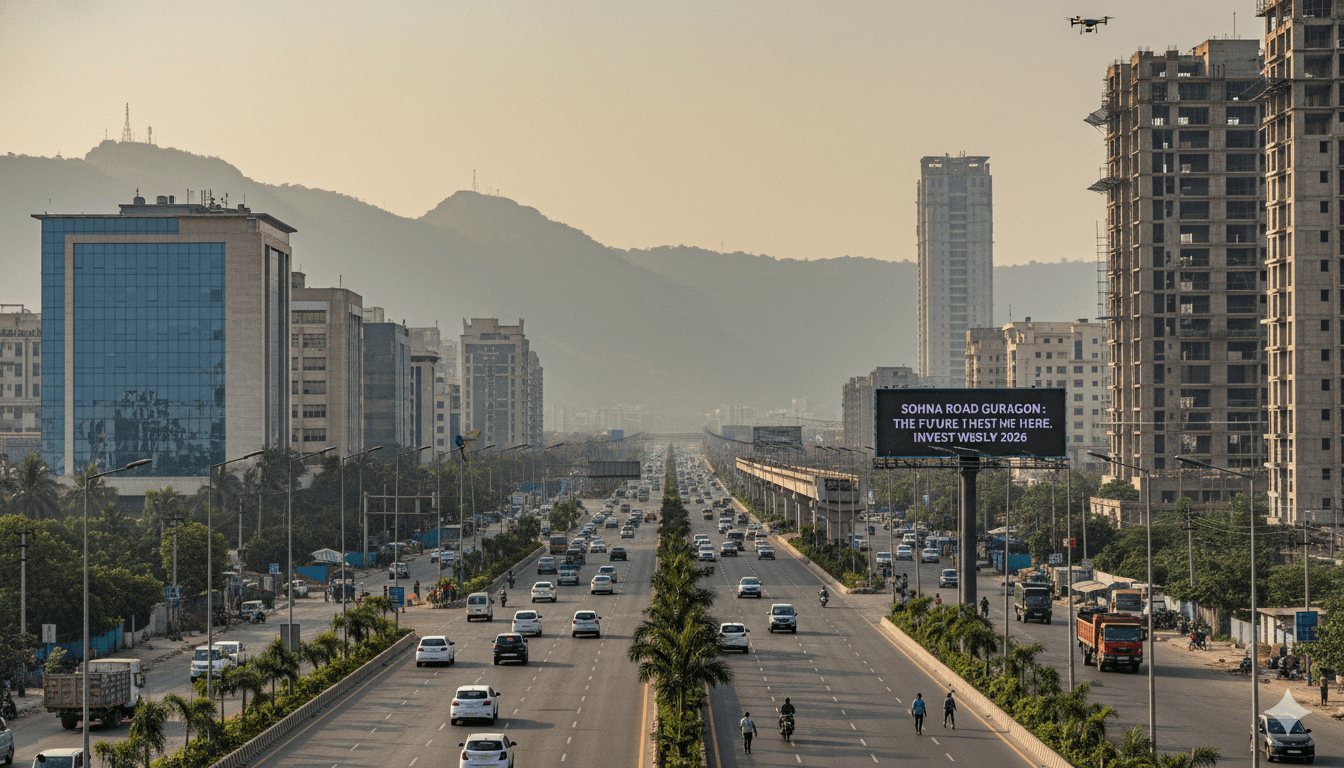
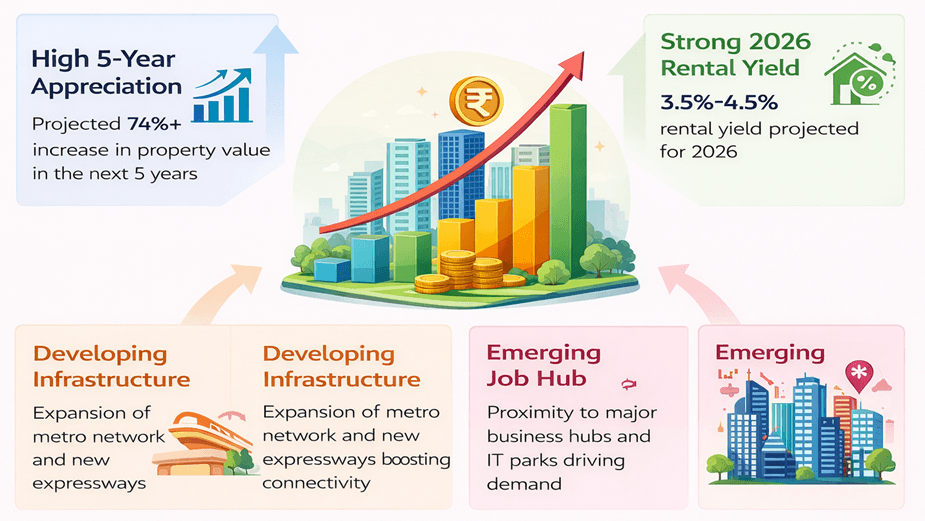
Sohna Road, Gurgaon has delivered 74%+ capital appreciation since 2021 and average flat prices are now rising 8–15% annually. With the Sohna Elevated Corridor (NH-248A) fully operational, the Delhi–Mumbai Expressway adding pan-India connectivity, a Gurgaon Metro extension in active planning, and 16,000+ new housing units under development, Sohna Road remains the highest-ROI real estate corridor in NCR in 2026 — and still the most affordable entry point in the Gurgaon market.
Table of Contents
Why Property on Sohna Road Gurgaon is a Smart Investment in 2026
For years, Gurgaon’s real estate narrative revolved around Golf Course Road, DLF phases, and Dwarka Expressway. Those corridors have largely plateaued — prices in established Gurgaon zones now cross ₹1 lakh per sq ft, leaving little room for meaningful capital appreciation. Sohna Road, Gurgaon is the data-backed answer that savvy investors have moved toward — and the 2026 numbers validate that move decisively.
Here is why property in Sohna Road Gurgaon continues to outperform every other NCR corridor in 2026:
- 74% capital appreciation recorded on Sohna Road between end-2021 and Q2 2025 — and prices are still rising
- 8–15% annual price growth expected through 2026, driven by infrastructure delivery and rising corporate demand
- Average 2BHK rent: ₹37,500–₹42,000/month (up 50%+ from 2022 levels)
- Entry pricing: ₹9,800–₹14,000/sq ft vs ₹1 lakh+ in premium Gurgaon zones — still the most affordable quality micro-market in NCR
- 16,000+ new housing units under development across the Sohna micro-market over the next 2–3 years
- DDJAY plot prices have risen from ₹60,000–₹80,000 per sq yard in 2023 to ₹1.25–1.50 lakh by late 2025
- Sohna Master Plan 2031 — legally backed statutory growth plan with 6,110 hectares of planned development, 28% reserved for residential
| 2026 Investment Signal Property prices on Sohna Road are forecast to rise 8–15% in 2026, with the Delhi–Mumbai Expressway now partially operational, a Gurgaon Metro extension in active planning, and IMT Sohna generating consistent residential demand from industrial workers and professionals. Buyers entering in early 2026 are doing so before the next major price inflection. |
For a broader view of why Sohna has emerged as NCR’s hotspot, read: Why Sohna Has Become the New Real Estate Investment Hotspot of NCR.
1. Sohna Elevated Corridor (NH-248A): Complete 2026
The Sohna Elevated Corridor is the single most transformative infrastructure project for Sohna Road real estate — and as of 2026, it is fully operational and delivering exactly the connectivity uplift analysts predicted.
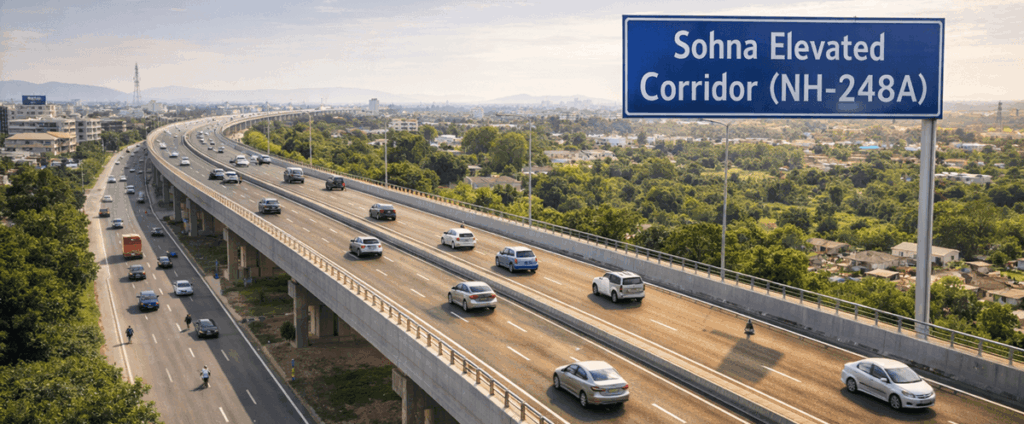
Here are the complete details:
| Parameter | Details |
| Official name | NH-248A — Sohna Elevated Expressway |
| Total length | 21.65 km (6-lane, access-controlled, signal-free) |
| Route | Rajiv Chowk / Subhash Chowk → Badshahpur → Sohna |
| Section 1 | 8.94 km — Subhash Chowk to Badshahpur |
| Section 2 | 12.74 km — Badshahpur to Sohna |
| Service roads | 3-lane service roads constructed on both sides |
| Operational since | July 2022 (fully operational; no phase delays) |
| Project cost | ₹1,466 crore (NHAI-executed) |
| Travel time (2026) | Gurgaon to Sohna in under 25–30 minutes (was 60–90 min pre-2022) |
| Key connection | Links directly to Delhi–Mumbai Expressway at Sohna end |
| Real estate impact | 50–74% price appreciation directly attributed to this corridor since 2021 |
By 2026, the Sohna Elevated Corridor has made Sohna Road a mainstream daily commuting corridor. IT professionals in Cyber City and Udyog Vihar now routinely live on Sohna Road — a pattern impractical before 2022. This shift is permanent, not cyclical. It directly underpins the appreciation seen in projects like Tathastu Sector 5 and Tathastu Sector 35.
2. Nearest Metro Station to Sohna Road Gurgaon
Metro connectivity is consistently the most-searched question among Sohna Road property buyers. Here is the complete, current picture as of 2026:
Currently Operational Nearest Metro Stations:
| Station | Metro Line | Distance from Sohna Road | Travel Time |
| Sector 55-56 | Rapid Metro (Yellow Line extension) | ~6.98 km | 15–20 min |
| Millennium City Centre (HUDA City Centre) | Yellow Line | ~9.36 km | 20–30 min |
| Sector 54 Chowk | Rapid Metro | ~7.5 km | 18–22 min |
| MG Road | Yellow Line | ~12 km | 25–35 min |
Upcoming Gurgaon Metro Extension to Sohna Road Gurgaon
A Gurgaon Metro extension connecting the existing Yellow Line network to Sohna Road is in active planning as of 2026. Haryana government proposals include a corridor that would bring metro access to Sohna Road proper — eliminating the current 7–9 km cab-to-metro gap that buyers frequently cite.
Historical evidence from every NCR metro corridor is consistent: even the announcement phase of a new metro line drives 20–35% price appreciation in adjacent micro-markets. Dwarka Expressway saw this pattern clearly — buyers who entered before the metro announcement captured the largest gains.
Sohna Road’s current pricing has not yet priced in this metro extension, making 2026 a compelling entry window for investors who understand this dynamic.
| Connectivity in 2026: The Full Picture Sohna Road connects to IGI Airport via NH-48 (~40 km, 40–55 min) | Faridabad via NH-248A + KMP Expressway (~28 km, 30–40 min) | Delhi South via NH-48 (~45 km, 45–60 min) | Delhi–Mumbai Expressway directly from Sohna. This multi-directional connectivity is why demand comes from across NCR — not just Gurgaon residents. |
Compare this with Dwarka Expressway, which saw exactly this appreciation pattern when its metro was announced. See: Why Dwarka Expressway Is Gurgaon’s Hottest Property Market.
3. New Projects Launches on Sohna Road Gurgaon (2026)
The Sohna Road project pipeline in 2026 is the most active it has ever been. Here is a current overview of projects across the Ganga Realty portfolio — the developer most committed to the Sohna micro-market:
| Project | Location | Type & Config | Status in 2026 |
| Tathastu Sector 5 | Sector 5, Sohna | Affordable Luxury | 2 BHK + Study | Under construction — RERA approved |
| Tathastu Sector 35 | Sector 35, Sohna | Affordable Luxury | 2 BHK + Study | Under construction — RERA approved | Strong appreciation since launch |
| New Project — Sector 9-10, Sohna | Sectors 9-10, Sohna | Residential | 2 & 3 BHK | New launch in 2026 — early-mover pricing available |
| Nandaka Sector 84 | Sector 84, Gurgaon | Premium Luxury | 3 & 4 BHK | Under construction — benefits from Sohna Rd + SPR corridor |
| Anantam 85 | Sector 85, Gurgaon | Premium Luxury | 3 & 4 BHK | Under construction — near Sohna Road elevated corridor |
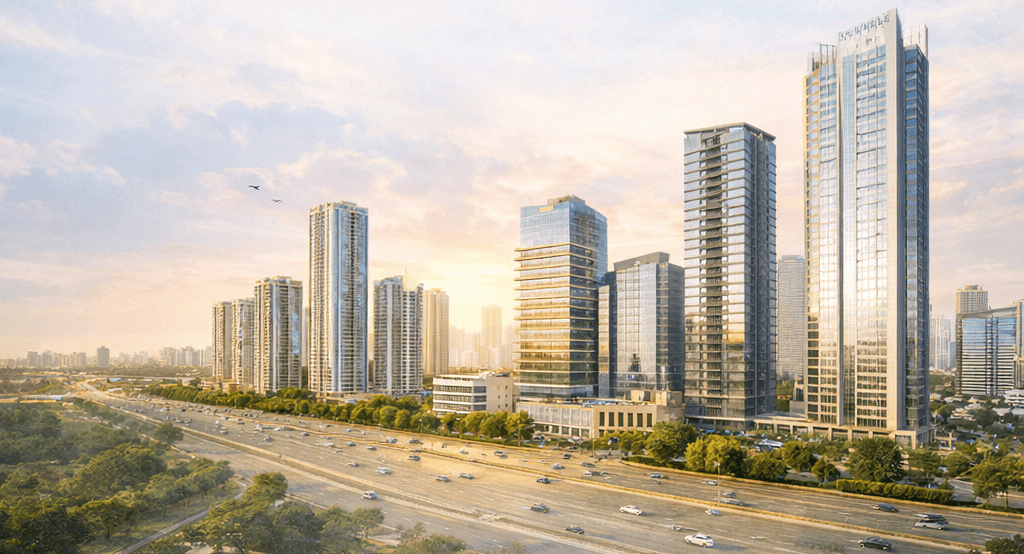
All Ganga Realty projects are RERA-registered and IGBC green-building certified — the only major developer in the Sohna micro-market with this combination. Buyers in Tathastu Sector 5 have already seen significant appreciation since launch; the same trajectory is expected for Tathastu Sector 35 and the new Sohna Sector 9-10 launch as infrastructure milestones continue to be delivered.
| Why Sectors 9-10, Sohna is the 2026 Early-Mover Opportunity Located at the heart of Sohna’s most rapidly developing zone, Sectors 9-10 sit within the Sohna Master Plan 2031 notified area, benefit from Delhi–Mumbai Expressway proximity, and are within 8 km of IMT Sohna — a major industrial township generating consistent residential demand. This is the same entry timing that Tathastu Sector 5 buyers captured in 2021–22. |
5. Flats in Sohna Road Gurgaon: 2026 Pricing, BHK Options & Best Sectors
Here is a current market snapshot of flat prices and rental yields across configurations on Sohna Road Gurgaon as of 2026:
| Configuration | Price Range (₹) | Carpet Area | Monthly Rent (2026) |
| 1 BHK | ₹35–50 Lakh | 450–600 sq ft | ₹14,000–20,000 |
| 2 BHK | ₹60–95 Lakh | 800–1,100 sq ft | ₹32,000–45,000 |
| 3 BHK | ₹95 L – ₹1.5 Cr | 1,200–1,600 sq ft | ₹48,000–70,000 |
| 4 BHK Luxury | ₹1.6 Cr – ₹3.5 Cr+ | 2,000–3,200 sq ft | ₹90,000–1.6 L |
Note: Prices across all configurations have appreciated 8–15% from the same period in 2025, consistent with the corridor’s established annual growth trajectory. Under-construction projects — particularly the new Sohna Sector 9-10 launch — offer lower entry prices with higher appreciation potential vs ready-to-move inventory.
Best Sectors for Property on Sohna Road Gurgaon in 2026
- Sector 5 & 35, Sohna: Highest growth potential in the affordable-luxury segment — DDJAY plots and RERA-compliant residential projects. Best for long-term appreciation investors and first-time homebuyers
- Sectors 9–10, Sohna: The 2026 early-mover window — new project launches at pre-appreciation pricing, direct Delhi–Mumbai Expressway benefit
- Sectors 48–70 (Gurgaon side of Sohna Road): Established micro-market with ready social infrastructure, schools, malls, and healthcare — premium segment, strong rental demand. For an overview of what premium living looks like in Gurgaon, see: Top Amenities That Define Luxury Residential Properties in Gurgaon.
- Sectors 84–86 (Dwarka Expressway overlap): Benefits from both major corridors simultaneously — strong rental yield, corporate tenant base. Explore Nandaka Sector 84 and Anantam 85 for the best projects at this junction.
For a detailed look at why affordable housing on Sohna Road makes sense for families: Why Affordable Housing in Gurgaon Is Becoming the Top Choice for Families.
5. Best Luxury Builders in Sohna Gurgaon (2026)
Ganga Realty committed to the Sohna micro-market before it became mainstream — a signal of genuine conviction, not trend-following. Every Ganga Realty project in Sohna is RERA-compliant, IGBC green-building certified, and designed for real family living: spacious layouts, earthquake-resistant construction, 24/7 security, and landscaped open spaces.
Buyers in Tathastu Sector 5 have already seen this thesis validated through both possession delivery and capital appreciation.
Developer Due Diligence Checklist
- RERA registration — verify on the Haryana RERA portal before signing
- Delivery track record — check for delays on previous projects
- Green building certification — IGBC or GRIHA rating confirms quality
- Payment plan — construction-linked is safer than time-linked
- Litigation history — search developer + project name on RERA complaints portal
Read our detailed project blog: Why Nandaka Is an Ideal Choice for Luxury Residential Projects in Gurgaon.
6. Sohna Road vs Other Gurgaon Corridors: ROI Comparison 2026
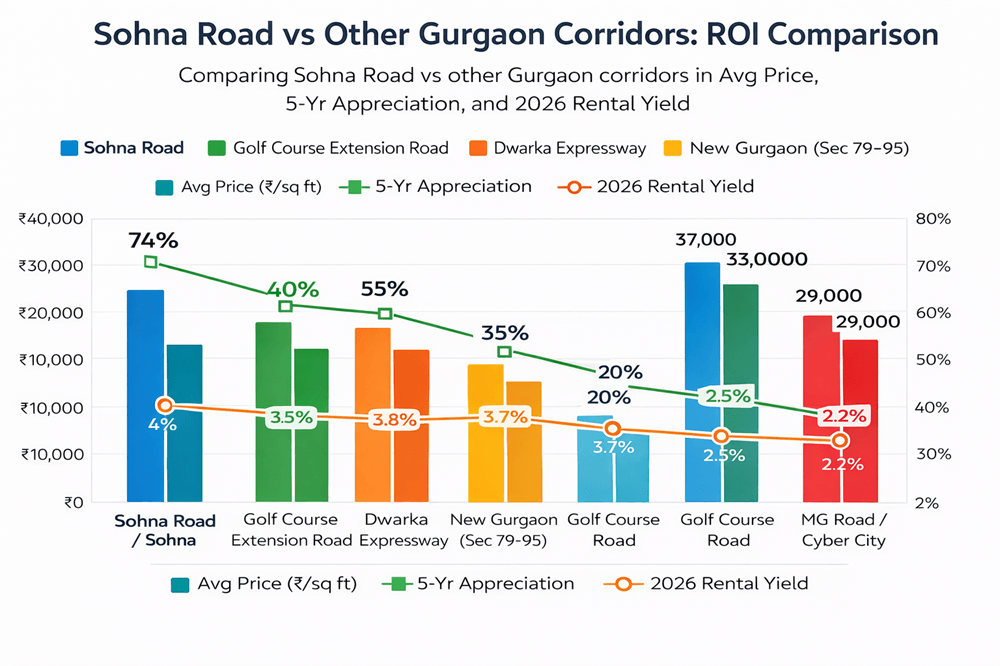
This is the data that separates smart capital allocation from market noise. Here is how Sohna Road stacks up against every major Gurgaon investment corridor in 2026:
| Corridor | Avg Price (₹/sq ft) | 5-Yr Appreciation | 2026 Rental Yield | Annual Growth Forecast | EntryOpportunity |
| Sohna Road / Sohna | ₹10,500–₹15,000 | 74%+ | 3.5–4.5% | 8–15% | HIGH — still rising |
| Golf Course Extension Road | ₹15,000–₹22,000 | 35–50% | 2.8–3.5% | 5–8% | MEDIUM — maturing |
| Dwarka Expressway | ₹13,000–₹20,000 | 45–60% | 3.0–3.8% | 6–9% | MEDIUM — plateau nearing |
| New Gurgaon (Sec 79–95) | ₹9,500–₹13,000 | 30–40% | 3.2–4.0% | 7–11% | MEDIUM-HIGH |
| Golf Course Road | ₹24,000–₹50,000 | 18–28% | 1.8–2.5% | 3–5% | LOW — fully matured |
| MG Road / Cyber City | ₹20,000–₹38,000 | 12–20% | 2.2–2.8% | 2–4% | LOW — saturated |
The 2026 picture reinforces what 2025 data showed: Sohna Road delivers the highest appreciation percentage and rental yield at the lowest absolute entry price in the Gurgaon market. The combination of infrastructure delivery (expressway operational, metro incoming), statutory backing (Master Plan 2031), and affordable entry pricing is a rare convergence that typically lasts 3–5 years before the corridor matures.
Sohna Road delivers the highest appreciation percentage and rental yield at the lowest absolute entry price in Gurgaon. For a detailed comparison with Dwarka Expressway, see: Why Dwarka Expressway Is Gurgaon’s Hottest Property Market.
For the luxury sector appreciation story in Gurgaon: Luxury Apartment Boom in Gurgaon: How Sectors 84, 85, 78 & 89 Are Leading the Trend.
7. Commercial Investment on Sohna Road Gurgaon in 2026
While Sohna Gurgaon is primarily a residential powerhouse, commercial real estate on this corridor has quietly become one of the strongest value plays in Gurgaon in 2026.
Why Commercial Investment on Sohna Road Makes Sense in 2026
- IT & corporate migration is accelerating: Major IT companies and Fortune 500 firms continue leasing commercial space on Sohna Road — attracted by rents 40–60% lower than Cyber City / Golf Course Road, with equivalent expressway access
- Retail infrastructure already in place: Home Mall, R-Mall, Liberation Mall, ILD, and Mall and House are operational — creating a ready catchment for retail investment
- Sectors 5 & 35 commercial emergence: Ganga Realty’s commercial projects in Gurgaon are positioned for the next wave of SME office and retail demand driven by DMIC-adjacent activity
- DMIC proximity (Sector 35): Sector 35, Sohna sits near the Delhi-Mumbai Industrial Corridor — attracting industrial, logistics, and ancillary service investment from 2025 onward
- Commercial rental growth: Office rents on Sohna Road are projected to grow 12–18% annually in 2026 as the working population on the corridor expands and premium office supply remains limited
- Lower entry vs Gurgaon commercial hubs: Commercial property on Sohna Road is 45–65% cheaper per sq ft than comparable assets on Golf Course Road — with higher yield potential
For a detailed commercial investment case: Why Swarnim Offers Long-Term Value for Commercial Investment in Gurgaon
How to Reach Sohna Road from Faridabad, Delhi & Haryana
One of Sohna Road’s most underrated competitive advantages is its multi-directional NCR and Haryana connectivity — making it accessible to buyers, tenants, and commuters from across the region:
| Origin | Primary Route | Distance | Travel Time |
| Delhi (South / Saket) | NH-48 → Sohna Road | ~45 km | 45–60 min |
| Faridabad (centre) | NH-248A / KMP Expressway | ~28 km | 30–40 min |
| IGI Airport / Dwarka | NH-48 → Sohna Road | ~40 km | 40–55 min |
| Noida / East Delhi | DND Flyway → NH-48 → Sohna Road | ~55 km | 55–75 min |
| Rewari / South Haryana | NH-48 or KMP Expressway | ~45 km | 45–60 min |
| Bhiwadi / Rajasthan border | Delhi–Mumbai Expressway | ~60 km | 50–65 min |
| Manesar (IMT) | NH-248A / SPR | ~18 km | 20–30 min |
Sohna Road, Haryana is the most multi-directionally connected micro-market in the southern NCR. Buyers from Faridabad, professionals working near IGI Airport, and families relocating from South Delhi all find Sohna Road a practical and affordable alternative to congested inner-Gurgaon.
This geographic breadth of demand — not just local Gurgaon demand — is a structural demand driver that protects Sohna Road from the localized demand cycles that affect single-corridor markets.
Conclusion: Why Sohna Gurgaon is the Smartest Property Decision in 2026
Every major NCR real estate success story — Golf Course Road in the 2000s, Noida Expressway in the 2010s, Dwarka Expressway in the early 2020s — followed the same sequence: infrastructure commitment → developer entry → end-user discovery → price maturity. Sohna Road entered phase three (end-user discovery) in 2023–24 and is now transitioning to phase four.
But unlike those corridors, Sohna Road still has the Delhi–Mumbai Expressway delivering, the metro extension coming, and IMT Sohna industrial demand growing — meaning the appreciation runway extends further than typical corridor timelines.
Ganga Realty is building for the Sohna that is coming, not the Sohna of five years ago. Tathastu Sector 5, Tathastu Sector 35, and the new Sohna Sector 9-10 launch (2026 early-mover pricing) represent the full investment spectrum — from zero-risk ready homes to maximum-upside pre-launch opportunities.
Every major NCR real estate success story — Golf Course Road in the 2000s, Noida Expressway in the 2010s, Dwarka Expressway in the early 2020s — followed the same sequence: infrastructure commitment → developer entry → end-user discovery → price maturity. Sohna Road entered phase three (end-user discovery) in 2023–24 and is now transitioning to phase four. But unlike those corridors, Sohna Road still has the Delhi–Mumbai Expressway delivering, the metro extension coming, and IMT Sohna industrial demand growing — meaning the appreciation runway extends further than typical corridor timelines.
The 2026 investment case rests on five compounding factors:
- Sohna Elevated Corridor fully operational since 2022 — the commute problem is permanently solved
- Delhi–Mumbai Expressway connection — positioning Sohna as a gateway node on India’s most ambitious road infrastructure project
- Sohna Master Plan 2031 with statutory force — 6,110 hectares of planned development, 255 hectares earmarked for commercial along Eastern Peripheral Road
- Metro extension in planning — not yet priced into current values
- Aravalli greenery and low pollution — a lifestyle advantage that no amount of construction in Gurgaon’s core can replicate
| Ready to Invest in Property on Sohna Road Gurgaon in 2026? Contact Ganga Realty today: +91-9990084084 | info@gangarealty.com | gangarealty.com — Our team will walk you through current inventory, 2026 pricing, RERA documents, and payment plans across all active Sohna Road and Sohna projects. |
FAQ’s About Sohna Road Gurgaon
What is the nearest metro station to Sohna Road, Gurgaon in 2026?
As of 2026, the nearest operational metro stations to Sohna Road are Sector 55-56 (Rapid Metro / Yellow Line) at approximately 6.98 km, and Millennium City Centre (HUDA City Centre) on the Yellow Line at approximately 9.36 km. Both are reachable by auto-rickshaw or cab in 15–30 minutes. A Gurgaon Metro extension to Sohna Road is in active planning — when this is officially announced, it is expected to trigger 20–35% price appreciation in adjacent properties based on historical NCR metro corridor patterns.
Which are the best sectors to buy property on Sohna Road in 2026?
For the best combination of appreciation potential and affordability, Sectors 5 and 35 in Sohna remain the top picks in 2026 — RERA-compliant projects, established developer presence, and strong infrastructure support. Sectors 9–10 are the 2026 early-mover opportunity: new launches in this zone are entering the market at pre-appreciation pricing before the full impact of the Delhi–Mumbai Expressway and metro extension is priced in. For buyers prioritising ready social infrastructure, Sectors 48–70 on the Gurgaon side of Sohna Road offer the best combination of connectivity, schools, healthcare, and retail access.
What is the Sohna elevated corridor and what has it done for real estate?
The Sohna Elevated Corridor (NH-248A) is a 21.65 km, 6-lane signal-free expressway connecting Rajiv Chowk in Gurgaon to Sohna, built at a cost of ₹1,466 crore by NHAI. Operational since July 2022, it reduced the Gurgaon-to-Sohna commute from 60–90 minutes to under 30 minutes. By 2026, its real estate impact has been decisive: 74%+ capital appreciation on Sohna Road since the corridor opened, a surge in residential project launches, major IT and Fortune 500 corporate office relocations to the area, and Sohna Road becoming a mainstream daily commuting corridor for Gurgaon professionals. It also provides direct access to the Delhi–Mumbai Expressway — adding pan-India logistics and connectivity value.
What is the price of flats in Sohna Road Gurgaon in 2026?
In 2026, flat prices on Sohna Road Gurgaon range from ₹35–50 lakh for 1 BHK units to ₹1.6–3.5 crore+ for 4 BHK luxury apartments. The most popular segment — 2 BHK flats — is priced between ₹60 and ₹95 lakh. Prices have appreciated 8–15% from 2025 levels, consistent with the corridor’s annual growth trajectory. Ready-to-move inventory (like Tathastu Sector 5 by Ganga Realty) eliminates construction risk. Under-construction projects, especially new 2026 launches in Sectors 9–10, offer lower entry prices and higher potential appreciation for investors with a 3–5 year horizon.
Who are the best luxury builders in Sohna Gurgaon in 2026?
Top RERA-registered developers active in Sohna and on Sohna Road Gurgaon in 2026 include Ganga Realty (Tathastu Sector 5 & 35 — IGBC green-certified, plus new Sector 9-10 launch), DLF, M3M India, Signature Global, and Raheja Developers. When evaluating a developer on Sohna Road, verify: RERA registration number, past possession delivery track record, green building certification (IGBC or GRIHA), construction quality, and payment plan flexibility. Ganga Realty’s Tathastu projects are the benchmark for this market — IGBC-certified, on-time delivery, and RERA-transparent.
How does Sohna Road connect to Faridabad in 2026?
Sohna Road connects to Faridabad via NH-248A and the KMP (Kundli-Manesar-Palwal) Expressway — a distance of approximately 28 km, covered in 30–40 minutes under normal traffic. The Delhi–Mumbai Expressway, now progressively operational, further strengthens this east-west connectivity. For professionals working in Faridabad’s Sector 58, Mathura Road industrial zone, or the YMCA-Ballabgarh commercial belt, Sohna Road offers a genuinely practical residential alternative — at 40–60% lower property prices than equivalent Faridabad micro-markets.
Is it the right time to buy property on Sohna Road Gurgaon in 2026?
2026 represents one of the last optimal entry windows on Sohna Road before the metro extension announcement and the full operationalisation of the Delhi–Mumbai Expressway price-in. The elevated expressway has already delivered (the trigger happened), prices are rising but haven’t plateaued, the metro hasn’t been priced in yet, and new project launches in Sectors 9-10 offer early-mover pricing.
Buyers entering in 2026 position themselves ahead of the next appreciation wave. For conservative buyers, ready-to-move inventory in Tathastu Sector 5 eliminates construction risk entirely while still offering strong rental yield and long-term appreciation.