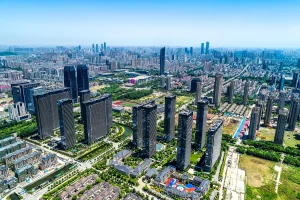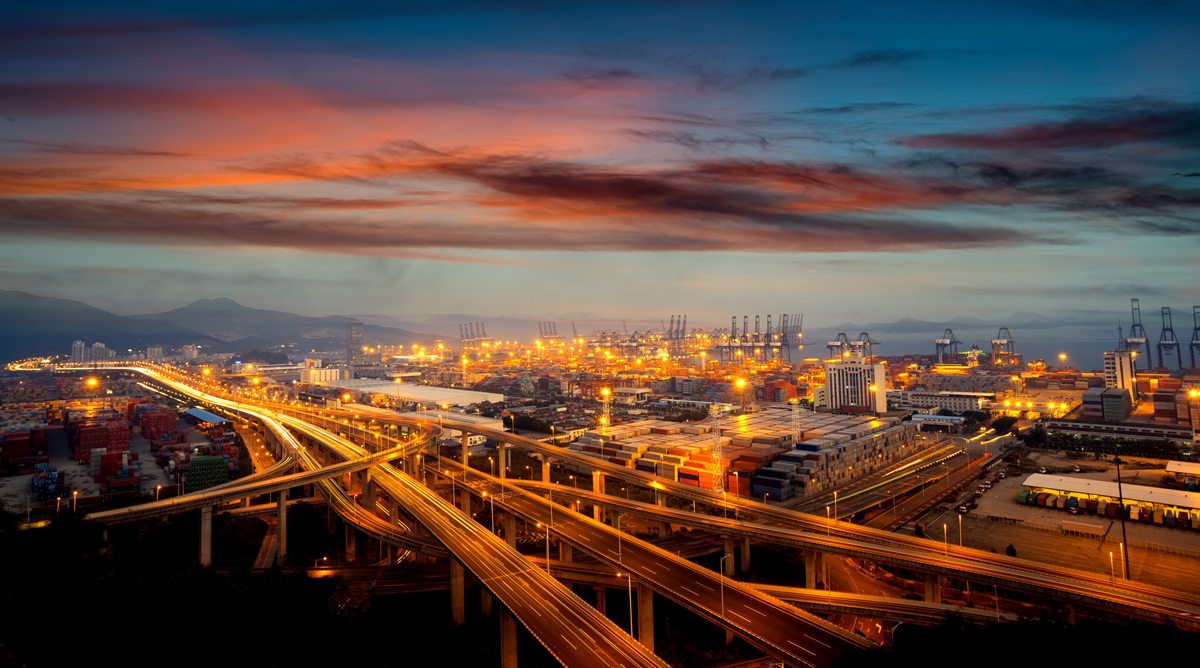
India is entering a new phase of infrastructure-led urban development. From expressways and airports to industrial corridors and integrated townships, the geography of growth is changing rapidly. One of the most significant developments is the government’s push towards smart industrial cities under the National Industrial Corridor Development Programme (NICDP).
In August 2024, the Union Cabinet approved 12 new industrial nodes and cities across India with an estimated investment of ₹28,602 crore. The projects are designed around integrated infrastructure, plug-and-play industrial facilities, multimodal connectivity and the “walk-to-work” concept.
For India’s real estate sector, the implications could extend well beyond industrial land. As manufacturing, logistics and businesses establish themselves around these emerging hubs, they can create employment, attract population and increase demand for housing, rentals, retail, offices, warehouses and social infrastructure.
As infrastructure and employment opportunities continue to reshape the NCR, Gurgaon real estate remains closely connected to the city’s expanding business and residential ecosystem.
For developers such as Ganga Realty, the evolution of New Gurgaon and its surrounding infrastructure corridors provides an important example of how residential development can align with a broader economic and urban transformation.
What Are Smart Industrial Cities?
Smart industrial cities are planned economic and urban development hubs that combine industrial infrastructure with modern urban planning. Unlike conventional industrial estates, the objective is to create integrated ecosystems where businesses can access:
- Industrial land
- Roads and transportation
- Utilities
- Logistics infrastructure
- Digital connectivity
- Commercial facilities
- Residential development
- Social infrastructure
- Sustainable urban systems
The NICDP is designed to create industrial nodes with world-class infrastructure and ready-to-use facilities intended to attract investment and manufacturing activity.
The broader objective is not simply to build factories. It is to create economic centres around which cities and communities can develop. And that is where real estate becomes an important part of the story.
India’s New Industrial Cities Under NICDP
The 12 new industrial cities approved under the NICDP span multiple states and industrial corridors. They include industrial nodes in:
- Haryana
- Uttar Pradesh
- Rajasthan
- Punjab
- Maharashtra
- Kerala
- Bihar
- Telangana
- Andhra Pradesh
- Uttarakhand
The approved projects include IMC Hisar in Haryana, IMC Agra and IMC Prayagraj in Uttar Pradesh, Jodhpur-Pali-Marwar in Rajasthan, Rajpura-Patiala in Punjab and other industrial areas across the country.
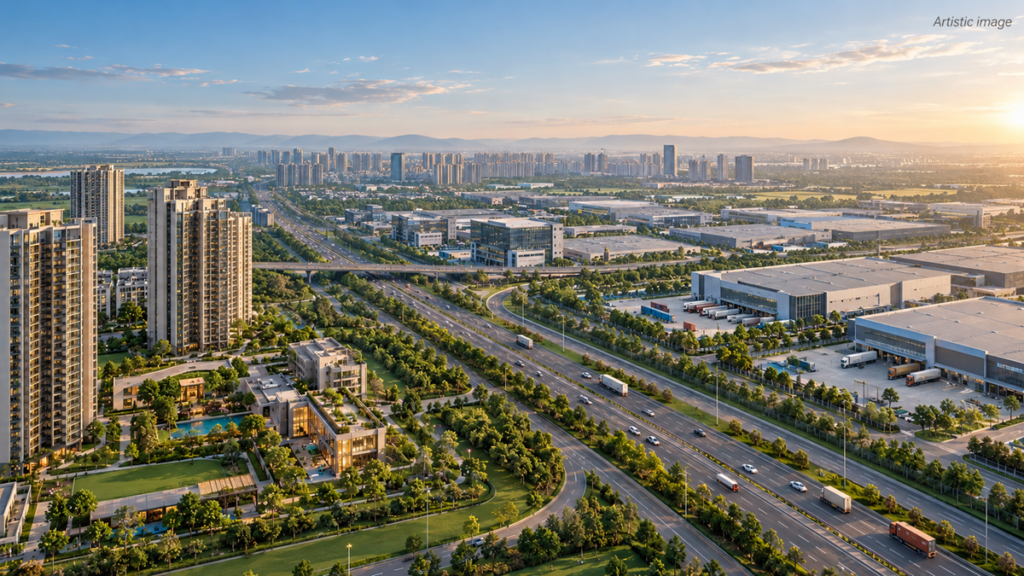
The programme has also moved from approval toward execution. As of February 2026, SPVs had been established for all 12 projects, with EPC contractors appointed for nine. More recently, the Economic Survey 2025–26 reported that Phase-I NICDP cities had already attracted ₹2.02 lakh crore in investment, creating jobs in high-growth sectors including EVs and semiconductors.
The Union Budget 2026–27 backed this further with a ₹3,000 crore allocation to the National Industrial Corridor Development and Implementation Trust (NICDIT) and the announcement of a new Integrated East Coast Industrial Corridor, adding a Durgapur node to the programme’s reach.
This progression matters because the real estate impact of infrastructure is generally tied to actual implementation, connectivity and economic activity — not announcements alone.
Why Industrial Development Matters to Real Estate
Real estate growth is closely connected with economic activity. A simple relationship can be illustrated as:
Industrial Investment
↓
Businesses & Manufacturing
↓
Employment
↓
Population Movement
↓
Housing Demand
↓
Retail & Commercial Development
↓
Urbanisation
When companies establish operations in a particular region, employees and supporting businesses often need places to live, work and operate.
This can create demand for multiple property categories.
Residential
- Apartments
- Plotted developments
- Builder floors
- Rental housing
- Affordable housing
- Premium residences
Commercial
- Offices
- Retail
- Restaurants
- Hotels
- Business centres
Industrial & Logistics
- Warehouses
- Distribution centres
- Industrial sheds
- Logistics parks
- Ancillary manufacturing facilities
This is why industrial infrastructure can influence the broader property ecosystem.
How Industrial Growth Can Influence Housing Demand
Employment is one of the most important long-term drivers of housing demand. Consider a hypothetical industrial hub that attracts thousands of employees. Those employees need homes. Some may rent initially. Others may eventually purchase. As families move into the area, demand can expand towards:
- Schools
- Hospitals
- Shopping centres
- Restaurants
- Parks
- Entertainment
- Fitness facilities
- Public transportation
Over time, an industrial centre can therefore become part of a larger urban ecosystem.
However, this process is not automatic. The scale of the effect depends on factors such as the number of jobs created, the quality of infrastructure, connectivity, housing supply and the pace at which supporting amenities develop.
What This Could Mean for Gurgaon
Gurgaon, or Gurugram, provides an interesting example of how employment and infrastructure can influence residential development. The city has evolved from a satellite town into one of India’s major corporate and commercial centres. Its residential geography has expanded alongside business districts, highways, expressways and emerging infrastructure corridors.
Today, New Gurgaon is an important part of this broader development story. Areas around sectors such as 78, 84, 85 and 89 have increasingly become part of the city’s expanding residential landscape. The connection between infrastructure and housing is particularly visible around major corridors such as:
- Dwarka Expressway
- NH-48
- Southern Peripheral Road
- Sohna Road
- Golf Course Extension Road
- Delhi-Mumbai Expressway connectivity
For homebuyers, the significance of these corridors is not simply travel convenience. They influence access to employment centres, education, healthcare, retail and other urban infrastructure.
New Gurgaon and the Changing Geography of Gurugram
New Gurgaon is developing as a broader residential ecosystem supported by major transportation links and expanding social infrastructure — creating room for larger residential communities built around open spaces, modern amenities, landscaped environments and wellness facilities.
Ganga Realty’s residential portfolio sits inside this shift, with developments across four New Gurgaon locations:
- Nandaka 84 (Sector 84): Positioned near Dwarka Expressway and NH-48, offering 3, 4 and 5 BHK residences and penthouses built around spacious layouts, greenery and wellness amenities.
- Anantam 85 (Sector 85): An ultra-luxury high-rise development reaching up to 60 storeys, with multiple clubhouses, a business centre, wellness amenities and AI-enabled home features.
- Ganga Valley 78 (Sector 78): Integrated township living with lush green spaces and a complete lifestyle ecosystem.
- Ganga Kashi Residences (Sector 89): Premium residential development offering peaceful living with contemporary amenities.
Together, these projects illustrate a broader shift in how modern homebuyers evaluate location — not by distance from a central business district alone, but through a combined lens:
Home + Connectivity + Work + Lifestyle + Social Infrastructure
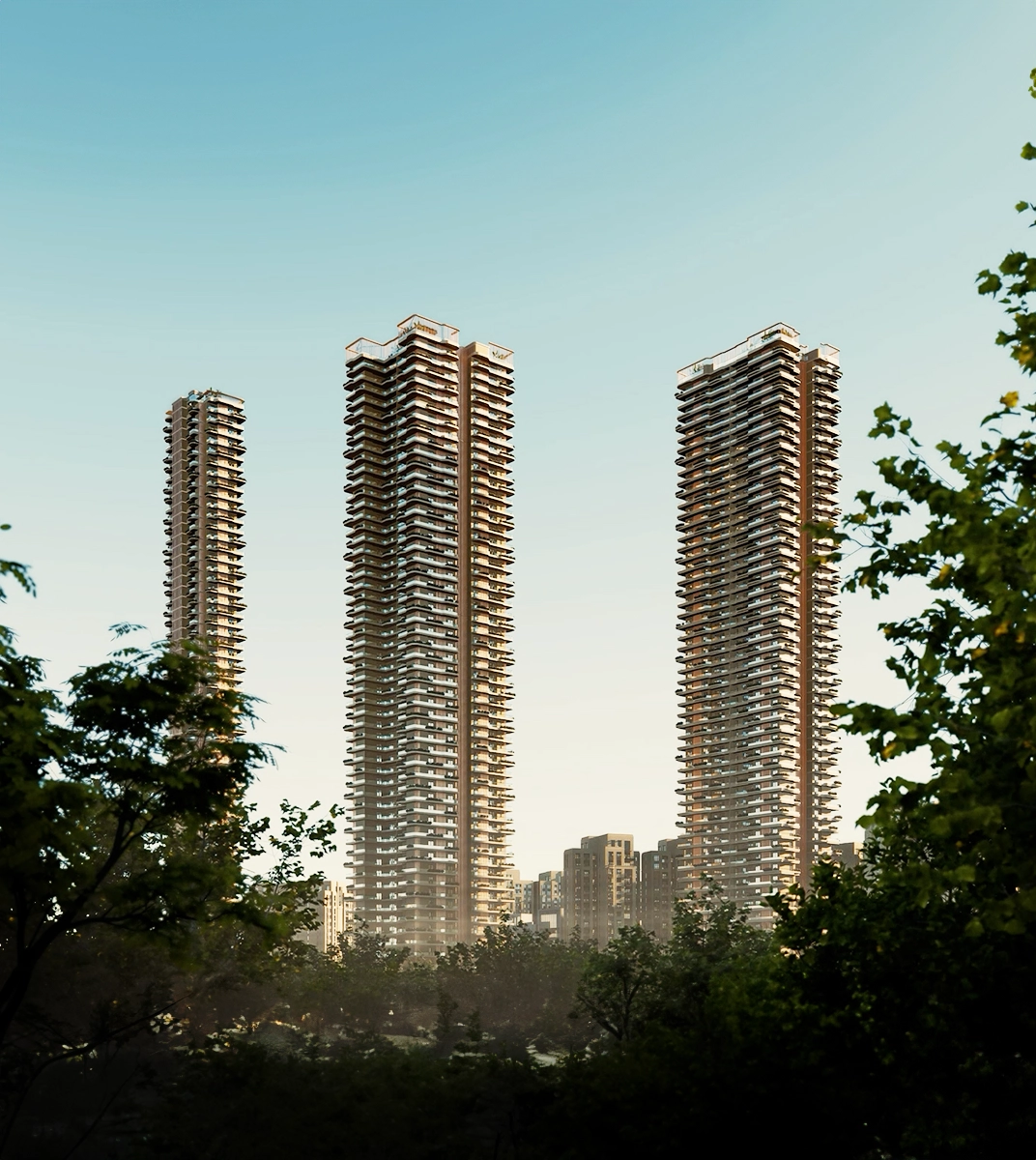
Anantam 85
Ultra-luxury residences on Dwarka Expressway offering expansive green spaces and world-class amenities.

Nandaka 84
Modern residential community in New Gurgaon designed for connectivity, comfort, and lifestyle.
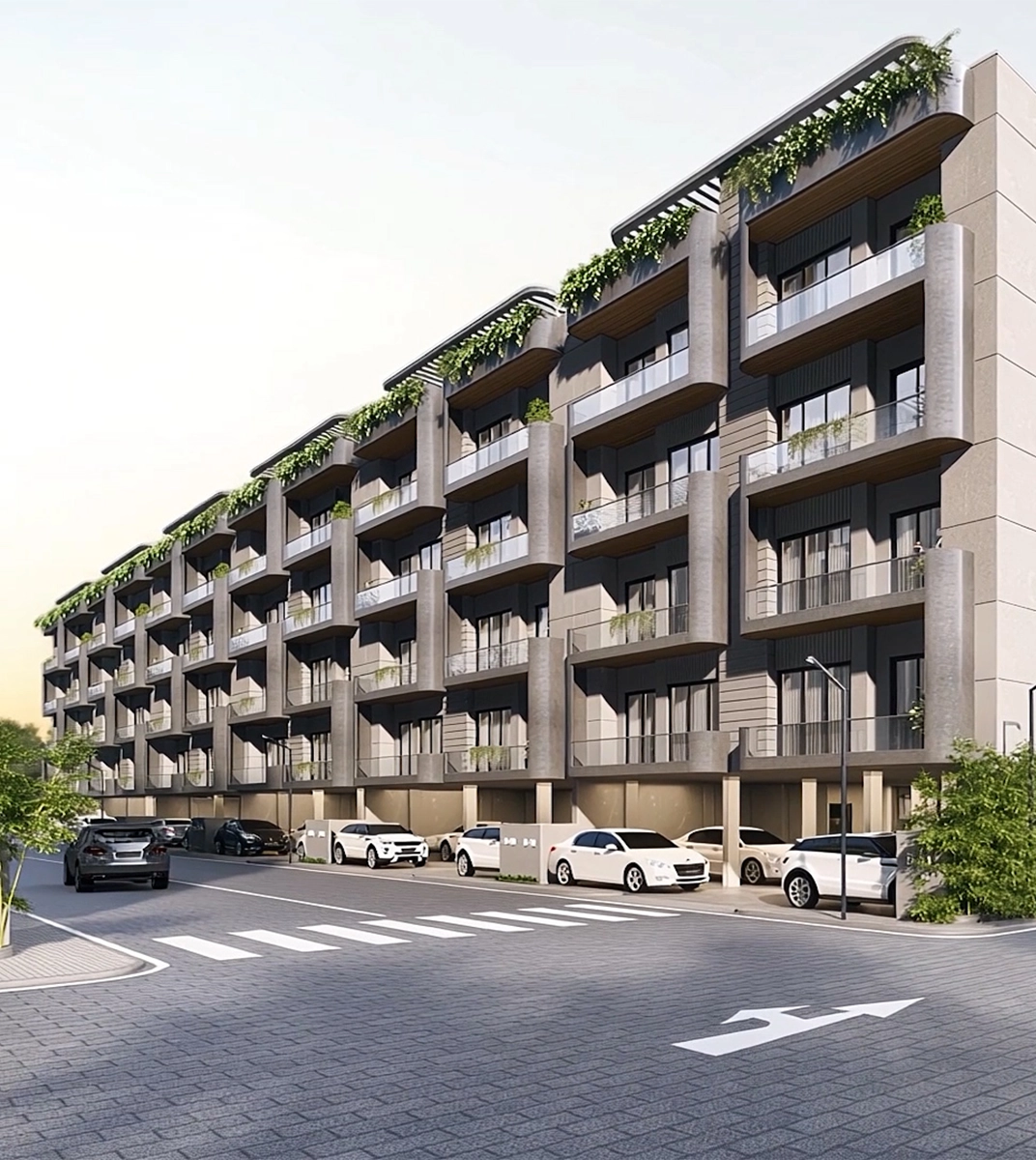
Ganga Kashi Residences
Premium residential development offering peaceful living with contemporary amenities.
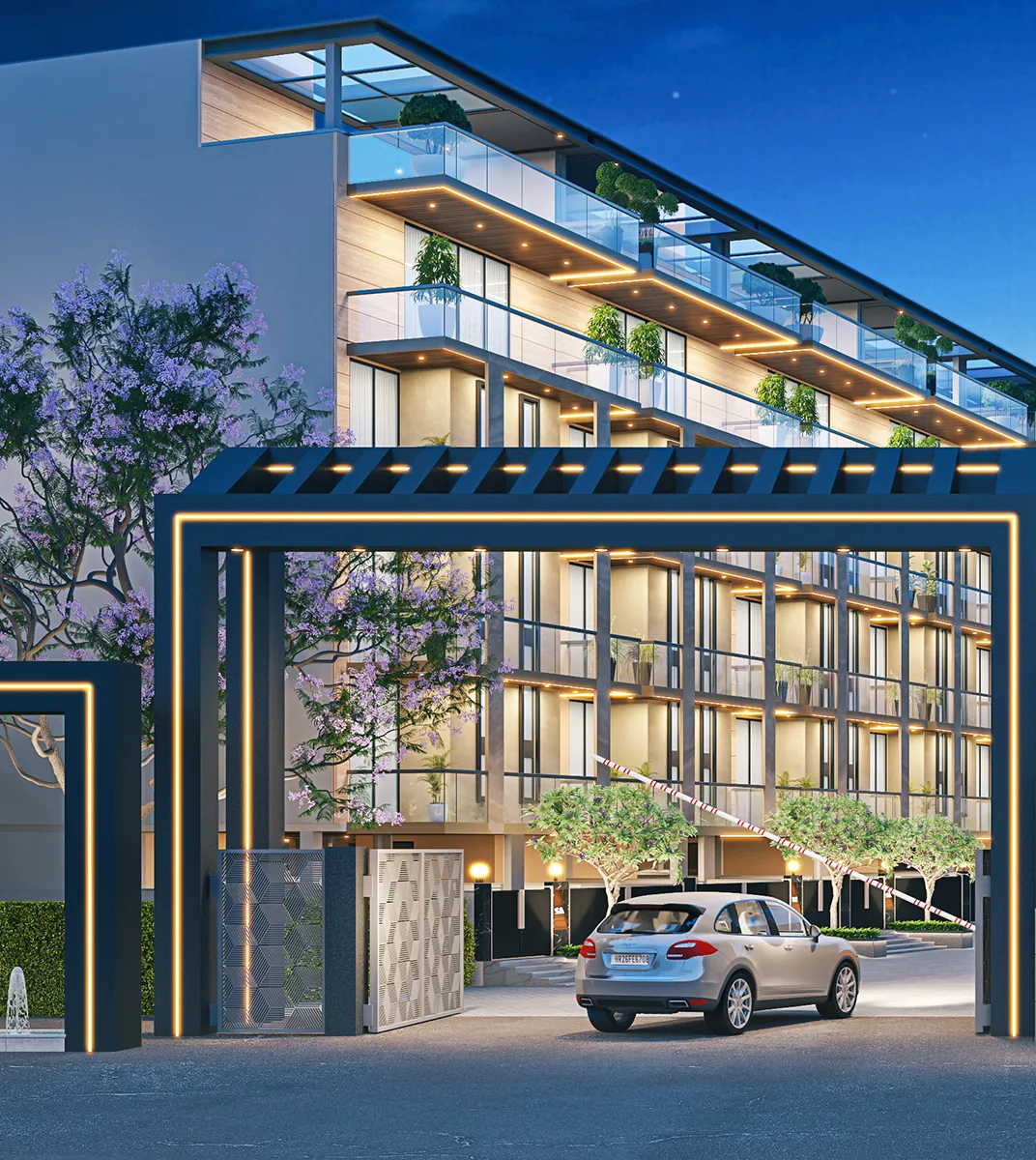
Ganga Valley 78
Integrated township living with lush green spaces and a complete lifestyle ecosystem.
The company's projects illustrate how luxury residential projects is increasingly being planned around the evolving infrastructure and lifestyle ecosystem of New Gurgaon.
Connectivity as a Driver of Property Demand
Industrial and residential development share one common requirement: connectivity. For industries, it determines how efficiently goods, employees and materials move. For residents, it shapes daily commuting and access to social infrastructure. This is why major infrastructure corridors influence the development pattern of surrounding areas.
Gurgaon's Dwarka Expressway and NH-48 connect residential areas with wider regional networks, while the Southern Peripheral Road provides an important east-west link across the city. Nandaka 84 and Anantam 85 both sit within New Gurgaon's connectivity ecosystem — though buyers should always distinguish between existing infrastructure and proposed infrastructure when evaluating a location.
The development of major corridors such as Dwarka Expressway is also changing how homebuyers evaluate connectivity and residential locations across New Gurgaon.
Industrial Growth, Employment and Rental Housing
Industrial cities can also influence rental housing. Employees relocating for work may initially prefer renting instead of purchasing a property. This can create demand for:
- 1 BHK apartments
- 2 BHK apartments
- 3 BHK apartments
- Co-living accommodation
- Serviced residences
- Employee housing
As employment ecosystems mature, some renters may transition into homeowners. This creates a potential pathway from:
Employment → Rental Demand → Residential Ownership
Gurgaon has already demonstrated how employment-led migration can influence residential and rental markets. The city's large corporate ecosystem has created sustained demand for housing across multiple segments. The development of additional industrial and logistics hubs around the NCR could add another layer to this regional employment and housing network.
Logistics and Commercial Real Estate
The impact of industrial cities will not be limited to housing.
- Manufacturing requires logistics.
- Logistics requires warehouses and distribution centres.
- Businesses require commercial spaces.
- Employees require retail and services.
- This creates a broader property ecosystem.
Industrial development can therefore potentially stimulate demand for:
Industrial + Logistics + Commercial + Residential Real Estate
For Gurgaon and the wider NCR, this is particularly relevant because the region is already one of India's major corporate, logistics and consumption markets. The continued development of industrial and logistics infrastructure around the NCR can further strengthen the importance of connectivity between Gurgaon, Manesar, Delhi, Haryana and neighbouring economic centres.
Why Tier-2 and Emerging Cities Could Benefit
One of the most significant consequences of India's industrial corridor strategy could be the emergence of new economic centres outside established metropolitan markets. Industrial projects such as IMC Hisar in Haryana and industrial nodes in Uttar Pradesh, Rajasthan, Punjab and other states could support more distributed economic growth.
As these locations attract businesses and employment, surrounding real estate markets could gradually develop. The potential chain is:
Industrial Hub → Employment → Population → Housing → Retail → Social Infrastructure → Urbanisation
This could create new property markets while reducing the concentration of economic activity in a limited number of metropolitan areas.
What Property Buyers Should Watch
Infrastructure-led real estate growth requires careful evaluation. If you're considering a property near an emerging industrial or infrastructure corridor, weigh the fundamentals rather than future expectations alone:
- Actual Connectivity: Check existing roads, highways, rail connectivity and public transportation.
- Employment Creation: Confirm companies are actually establishing operations and generating jobs.
- Infrastructure Execution: Distinguish between announced, under-construction and operational infrastructure.
- Residential Supply: Study how much housing is already available versus planned.
- Social Infrastructure: Schools, hospitals, retail and recreational facilities shape long-term liveability.
- Rental Demand: Growing rental demand signals employment-driven population growth.
- Regulatory Approvals: Always verify project approvals, RERA registration, title documentation and other permissions.
Before making a property decision, buyers should also compare property rates in Gurgaon across different sectors and understand how location, connectivity and infrastructure influence pricing.
The Future of Gurgaon Real Estate
The future of Gurgaon is increasingly connected to the larger NCR economic ecosystem. The city's evolution is no longer driven by one road, one business district or one residential sector. Instead, multiple factors are interacting:
- Corporate Growth
- Industrial Development
- Logistics
- Expressways
- Metro & Public Transport
- Residential Development
- Social Infrastructure
Together, these factors can influence the city's next phase of urbanisation. Ganga Realty's developments in New Gurgaon provide one example of how residential projects are being created within this changing landscape.
From Nandaka 84 in Sector 84 to Anantam 85 in Sector 85, Ganga Realty is developing residential addresses within an area where infrastructure, connectivity and urban expansion are reshaping the residential market.
Other Ganga Realty developments, including Ganga Valley 78 and Ganga Kashi Residencies in Sector 89, further extend the company's residential presence across Gurgaon.
Conclusion
India's smart industrial cities could become important catalysts for the country's next phase of economic and urban development. The ₹28,602 crore programme across 12 new industrial cities represents a significant push toward integrated manufacturing and infrastructure — and as implementation progresses, the resulting employment, logistics and connectivity networks could influence surrounding urban markets.
For real estate, the opportunity may not come directly from industrial land itself, but from everything that develops around it: jobs, homes, retail, schools, healthcare, logistics, commercial spaces and better connectivity. Gurgaon's transformation into a major corporate and residential destination offers a working example of this interconnected model — and as New Gurgaon continues to evolve, projects like Nandaka 84 and Anantam 85 represent the residential side of that larger story.
For homebuyers, the key is to look beyond a property's immediate surroundings and understand the larger ecosystem of connectivity, employment, infrastructure, liveability and urban planning that shapes a location over the long term.