Buying a home in Gurgaon is not just a financial decision — it’s a long-term lifestyle and emotional investment. With rising property values, infrastructure growth, and evolving buyer preferences, today’s homebuyers are not just asking “Is this property affordable?” but also “Will this home support my family’s happiness, growth, and peace?”
Table of Contents
That’s where Vastu Shastra becomes relevant.
Choosing the right facing house as per Vastu helps align your home with natural energies, improving health, relationships, financial stability, and mental peace — factors that directly impact your quality of life. This guide is written specifically for urban homebuyers in Gurgaon, combining traditional Vastu wisdom with practical real-estate decision-making.
Defining House Facing: The Foundation of Vastu Direction Analysis
House facing in Vastu Shastra refers to the cardinal direction you face when standing at the main entrance and looking outward—not the direction from which you enter. This distinction is fundamental to Vastu principles, as it directly influences the cosmic energy flow and spiritual dynamics within your home.
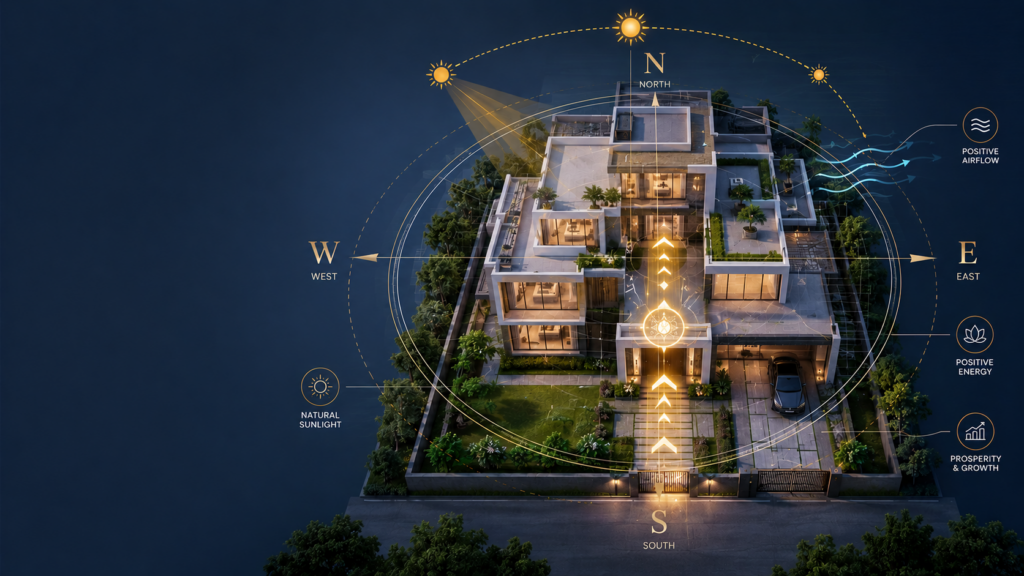
For example, if you stand inside your home at the main door and face toward the east as you exit, your house is considered east-facing. Similarly, a south-facing home means the main entrance directs outward toward the south. This seemingly subtle differentiation carries significant implications under Vastu philosophy, as each cardinal direction is believed to receive distinct planetary influences and energy frequencies that affect the inhabitants’ health, prosperity, and well-being.
Many property buyers and homeowners mistakenly assume that house direction is determined by the entrance’s position relative to the road or external structure. However, authentic Vastu assessment requires understanding the actual outward direction from the main door perspective. Grasping this concept correctly is the essential first step before evaluating which direction aligns best with your personal Vastu requirements and before making informed decisions about property investment in locations like Gurgaon, where directional properties command varying premiums in the real estate market.
What Does “House Facing” Mean for a Buyer?
House facing refers to the direction your main entrance faces, not the direction your plot or balcony faces.
Why it matters for buyers:
- It affects natural light, ventilation, and thermal comfort.
- It influences energy flow, which impacts mood, productivity, and harmony.
- It can affect resale value, as certain facings are more preferred in Indian markets.
In premium markets like Gurgaon, East, North, and Northeast-facing homes often command higher buyer interest and faster absorption.
Quick Buyer Comparison
| Buyer Type | Best Facing |
|---|---|
| Families | East / Northeast |
| Investors | North |
| Luxury buyers | Northeast |
| Professionals | East / North |
| Retirees | Northeast |
Best House Facing as per Vastu — Direction-wise Buyer Analysis
The direction a house faces is one of the most influential factors in Indian real estate purchasing decisions, driven by an intricate blend of Vastu Shastra principles, practical climate considerations, and investment potential.
1. Northeast Facing: The Most Auspicious Direction
Vastu Significance: Northeast-facing homes are universally recognized as the most auspicious in Vastu Shastra, associated with Ishanya Kona—the corner of divine energy presided over by Lord Shiva. This direction is believed to channel cosmic energy and attract prosperity, good health, and spiritual enlightenment.
Key Benefits for Residents:
- Uninterrupted flow of positive energy throughout the home
- Enhanced mental clarity and spiritual growth
- Improved family harmony and well-being
- Better physical and mental health outcomes
- Maximum morning sunlight with healing properties
Market Performance & Buyer Psychology:
Northeast-facing properties represent the gold standard in Indian real estate. These properties are consistently the most sought-after, with projects offering northeast-facing units selling out first. The property grade classification ranks northeast-facing homes as A-grade, the highest category. Buyers perceive these homes as spiritually blessed and emotionally satisfying, often overlooking price premiums due to cultural and psychological comfort.
Investment Implications:
In Gurgaon, northeast-facing plots with roads on the north and east sides command the highest valuations. Properties on Dwarka Expressway and Sector 84 and 85 show sustained premium demand for northeast-facing Vastu-compliant residences.
2. East Facing: The Most Preferred Practical Direction
Vastu Significance: East-facing homes are considered highly auspicious, governed by Lord Indra (the God of rain and thunder). The direction symbolizes new beginnings, health, and the rejuvenating energy of the rising sun.
Key Benefits for Residents:
- Abundant morning sunlight—gentle, healthy, and full of natural energy
- Promotes vitality, positive relationships, and good health
- Associated with wealth arrival, prosperity, and positivity
- Ideal for intellectual growth and spiritual progress
- Scientifically optimal for natural light and ventilation
Market Performance & Buyer Psychology:
East-facing homes are consistently the most preferred in India after northeast-facing properties. Housing surveys classify east-facing properties as A-grade, and they typically command the strongest buyer demand across all income segments. In Gurgaon, east-facing residential rates surged from ₹9,718 per square foot in 2023 to ₹16,186 per square foot in 2025, with new projects seeing east-facing units sold out first. These properties enjoy a 3–5% price premium in the resale market.
Investment Implications:
For NRI investors, east-facing properties offer the optimal balance between Vastu-compliance, practical living benefits, and market appreciation. The consistent preference makes these properties easier to rent and resell, reducing investment risk.
3. North Facing: The Prosperity Direction
Vastu Significance: North-facing homes are associated with Lord Kubera, the Hindu god of wealth and abundance. Vastu principles dictate that this direction promotes financial prosperity, career success, and business stability.
Key Benefits for Residents:
- Constant, balanced natural light throughout the day
- Attracts financial prosperity and career advancement opportunities
- Promotes business growth and stability
- Excellent energy efficiency—homes remain cooler in tropical climates
- Associated with Soma and Bhallat pada (auspicious zones)
Market Performance & Buyer Psychology:
North-facing properties consistently rank as the second most preferred direction after east. They attract strong buyer interest, particularly among business professionals and entrepreneurs who believe in the wealth-bringing potential. Anarock data shows that 80% of Indian homebuyers consider Vastu compliance crucial, and north-facing properties benefit substantially from this sentiment. These properties command premium pricing and maintain strong resale values.
Investment Implications:
For investment portfolios, north-facing properties in prime Gurgaon locations provide excellent rental income potential and appreciation, particularly for commercial and mixed-use developments. The steady, indirect light makes these homes comfortable year-round.
4. West Facing: The Neutral Direction with Caveats
Vastu Significance: West-facing homes are governed by Lord Varuna (associated with rain and water). While not inherently unfavorable, Vastu classifies west-facing properties as “C-grade,” requiring careful internal planning and remedies to maximize positive energy.
Key Benefits (With Proper Planning):
- Evening sunlight for aesthetic and comfort
- Associated with creativity, emotional balance, and security
- Suitable for artists and creative professionals
- Can work well if main entrance is repositioned to north or east
Challenges & Market Perception:
West-facing homes face afternoon and evening heat in India’s tropical climate, reducing energy efficiency and comfort. More critically, buyer preference remains significantly lower than east or north-facing properties, typically resulting in slower sales and potential 5–10% discounts. The property may feel hotter and less inviting during peak summer months. Market data indicates these properties require either exceptional amenities, premium views, or significantly lower pricing to attract qualified buyers
Investment Implications:
While not a poor investment, west-facing properties in Gurgaon generally appreciate more slowly and face longer holding periods before resale. These are better suited for end-users who can benefit from evening light views rather than pure investment plays. Successful west-facing properties often compensate with superior amenities, park views, or strategic location advantages.
5. Southeast Facing: The Inauspicious Direction
Vastu Significance: Southeast-facing homes are traditionally considered inauspicious in Vastu Shastra, governed by Agni (the fire element). This direction is believed to generate excessive heat, anger, disputes, and health issues among residents.
Key Challenges:
- Associated with anger, disputes, and family conflicts
- Excessive heat in tropical climates
- Believed to affect residents’ well-being negatively
- Increases chances of family disagreements
- Requires comprehensive Vastu corrections and remedies
Market Performance:
Southeast-facing properties face significant market headwinds, with lower demand and slower sales cycles. Buyers typically avoid these properties unless offered at substantial discounts. The psychological resistance to southeast-facing homes creates a persistent valuation discount.
Investment Implications:
Not recommended for primary investment strategies. If unavoidable, require professional Vastu consultation and strong remedial measures (interior repositioning, Hanuman imagery, specific gemstones). The property would need exceptional additional advantages to overcome directional disadvantages.
6. South Facing: The Direction of Caution
Vastu Significance: South-facing homes are traditionally associated with Lord Yama, the god of death, making this direction broadly discouraged in Vastu practice. However, modern Vastu experts acknowledge that with proper internal planning, south-facing homes can be made suitable for specific professional categories.
Key Challenges:
- Traditional association with death and misfortune
- Excessive heat in India’s tropical climate
- Typically receives harsh afternoon sun
- Lower buyer preference across all market segments
Market Performance:
South-facing properties suffer from approximately 10–15% valuation discount compared to east or north-facing equivalents. Buyers typically resist these properties unless significantly underpriced or unless the specific professional background aligns with Vastu’s traditional benefit.
Investment Implications:
Only consider for specific professional niches (politicians, administrators) or at substantial discounts where internal corrections can be implemented. Long holding periods should be anticipated.
7. Southwest Facing: The Direction to Avoid
Vastu Significance: Southwest-facing homes represent the least auspicious direction, associated with misfortune, instability, and negative energy. This direction is universally discouraged in Vastu Shastra and carries the strongest psychological resistance from Indian buyers.
Key Challenges:
- Direction of evil and maximum negative energy per Vastu
- Attracts misfortune and instability
- Associated with loss and adversity
- Requires extensive and expensive remedies
- Very difficult to remediate even with expert intervention
Market Performance:
Southwest-facing properties face the steepest market headwinds, with valuation discounts of 15–25% or higher. The 99acres survey indicates approximately 93% of homebuyers in Tier-1 and Tier-2 cities actively avoid southwest-facing properties. These properties have the longest sales cycles and highest buyer resistance.
Investment Implications:
Strongly recommended to avoid. Even with professional Vastu corrections, these properties remain challenging to market and resell. Not suitable for investment portfolios unless available at extreme discounts with significant additional advantages.
8. Northwest Facing: The Neutral-to-Moderate Direction
Vastu Significance: Northwest-facing homes are governed by Lord Vayu (wind) and associated with air circulation and social connections. These properties are generally neutral with moderate positive potential for business growth and social relationships.
Key Benefits:
- Good air circulation and ventilation
- Associated with social connections and business growth
- Suitable for those in business and social professions
- Moderate Vastu acceptability
Market Performance:
Northwest-facing properties occupy the middle ground in buyer preference, receiving moderate demand and neither significant premiums nor substantial discounts. These are often overlooked in favor of northeast, east, and north-facing options.
While choosing the best house facing depends on lifestyle and Vastu preferences, north-facing homes continue to remain one of the most preferred choices among buyers. Explore North Facing House Vastu: Simple Tips, Benefits & Complete Room Guide to understand its benefits, entrance placement, and room-wise recommendations.
Direction-Specific Buyer Psychology & Market Data
| Factor | Data Point | Market Implication |
|---|---|---|
| Buyer Preference Spread | 62% prefer Vastu-compliant homes nationally | Northeast & East-facing at highest demand; West, South, Southwest at lowest |
| Premium Willingness | Gurgaon shows a strong Vastu preference due to NRI population | East/Northeast properties justify 3–5% higher pricing |
| Regional Variation | 82% in Hyderabad prioritize Vastu; 11–17% in Mumbai/Pune | Gurgaon shows strong Vastu preference due to NRI population |
| Gurgaon Market | East-facing units sell first in new projects | Fast inventory turnover justifies premium positioning |
| Resale Velocity | East/North-facing command better resale value | Easier exits for investors; shorter holding periods |
| Price Range Data | Gurgaon average ₹16,186/sq ft (2026), Golf Course Road ₹35,000/sq ft. | Direction impacts pricing across all segments |
| Buyer Survey | 93% of Tier-1/2 city buyers prefer Vastu-aligned homes | South & Southwest-facing face 10–25% discounts |
Room Placement Guidelines by House Direction
| Room | Ideal Direction | Rationale |
|---|---|---|
| Kitchen | Southeast or Northwest | Southeast: Agni (fire element) location; Northwest: alternative if SE unavailable |
| Master Bedroom | Southwest | Stability, security, grounding, restful sleep |
| Children’s Room | Northwest, Southeast, or West | Northwest/SE for any direction; West-facing for concentration & study |
| Living Room | North, East, or Northeast | Attracts positive energy; promotes communication and bonding |
| Pooja Room | Northeast (primary), North/East (secondary) | Highest sacred energy concentration |
| Bathroom/Toilet | Northwest or Northern area | Avoid South, Southwest, Southeast |
| Balconies | North, East, or Northeast | Maximum sunlight and fresh air; positive energy flow |
| Garden | North, Northeast, or East | Auspiciousness; ensures healthy, vibrant greenery |
Conclusion
House facing direction in Vastu Shastra operates at the intersection of ancient architectural wisdom, climate science, and contemporary real estate psychology. In the Indian market, northeast and east-facing homes command both the highest buyer preference and measurable price premiums (3–5% in Gurgaon). This preference is neither purely superstition nor purely scientific—it combines genuine well-being benefits (morning light, natural energy flow, climate efficiency) with deep cultural psychology that drives buyer behavior and investment returns.
For property buyers and investors in Gurgaon and across India, understanding this direction hierarchy is critical to both maximizing long-term investment returns and ensuring family well-being. While direction is important, it should be balanced against location, amenities, layout quality, and ventilation. A well-designed east or north-facing property will consistently outperform a poorly designed northeast-facing one, but all else equal, directional preference remains a genuine market driver with quantifiable financial implications.
Ready to Find Your Vastu-Perfect Home?
🔗 Most Popular Guides:
🏠 Explore Our Vastu-Compliant Projects:
FAQ About South Facing House
Which rooms should be placed in a north facing house?
As per Vastu, the living room should ideally be in the north or east, the kitchen in the south-east, the master bedroom in the south-west, and the puja room in the north-east for balanced energy flow.”
Where should the main entrance be in a north facing house?
According to Vastu principles, the main entrance of a north facing house should ideally be positioned in the north or north-east zone to allow positive energy and prosperity into the home.”
Is a north facing house better than an east facing house?
Both north and east facing houses are considered favorable in Vastu. North facing homes are associated with wealth and opportunities, while east facing homes are preferred for natural light and positive energy.”
What are the benefits of a north facing house?
A north facing house is believed to support prosperity, improved energy flow, better natural lighting, career growth, and a harmonious living environment when planned according to Vastu principles.”