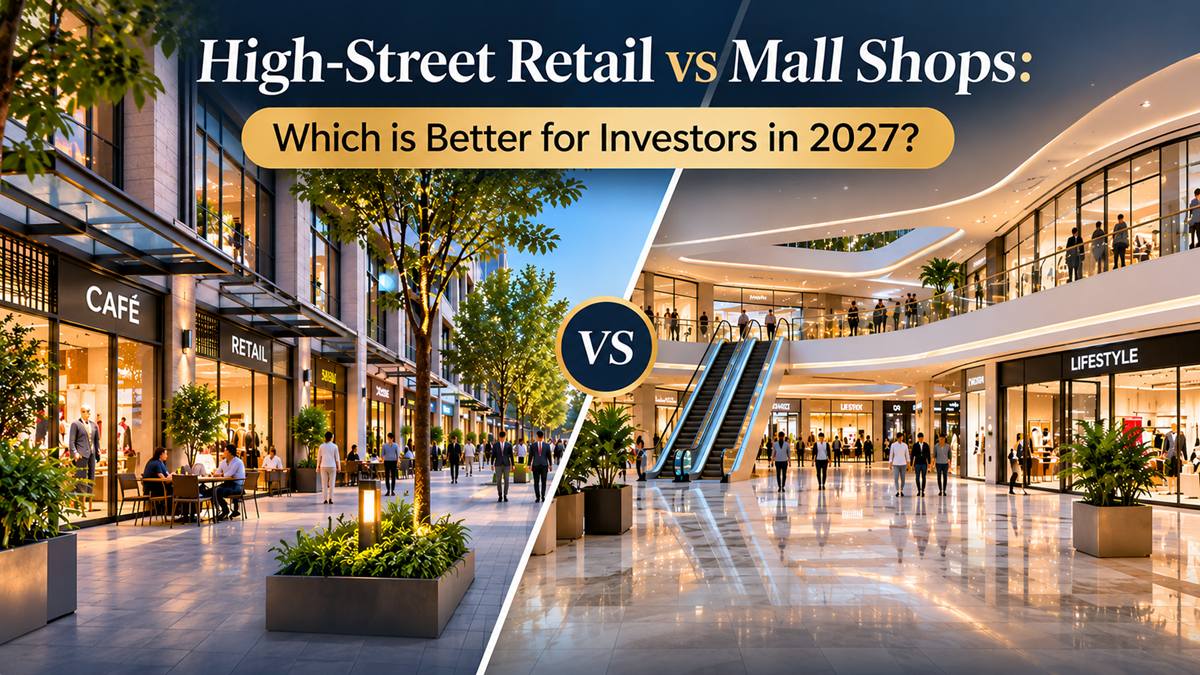
For most individual investors in Delhi-NCR, a well-located high street retail is still the better buy going into 2027. The gap with malls is likely to shrink, though.
Table of Contents
High streets won the last three years mostly because premium mall space was hard to find. That is changing. About 12.7 MSF of Grade A mall supply is due through 2028, led by Delhi NCR. More mall space gives brands more choices, and that can ease the pressure on street rents.
So the useful question for 2027 is which individual shop will keep its pricing power once the new malls open. Our short version: buy high street where frontage is truly scarce and the neighbourhood already has people in it. Buy a mall unit only if that mall’s vacancy is low and its operator has a record you can check.
What is high-street retail, and what are mall shops?
High-street retail means shops on open, road-facing commercial strips. Khan Market in Delhi and Galleria Market in Gurgaon are the well-known examples, and neighbourhood retail rows on busy roads are the everyday version. Customers walk in off the street, so frontage, parking and signage count for a lot.
A mall shop is a unit inside an enclosed shopping centre run by one operator. The operator picks the tenants, looks after the common areas and runs the marketing. Individual units in a mall are often not sold outright, and when they are, your return depends heavily on how well the mall is managed.
The two formats earn money differently. A high-street shop earns from its location and frontage. A mall shop earns from how the whole mall performs.
The 2027 market snapshot
High streets are heading into 2027 with momentum, and malls with a lot of new supply.
How 2026 ended. In Q3 2026, main streets took 67.9% of leasing across the top eight cities (1.51 MSF, up 33.1% year on year), while mall leasing fell 37.8%. Grade A mall vacancy dropped to 4.8%, and no new Grade A mall opened for the third quarter in a row. Prime high-street rents rose 6.8% over the year, though the gains were uneven from one location to the next. Anarock’s RELEAP 2026 found mall rents largely flat, with growth limited to the strongest Grade A assets.
The mall slowdown tells you about supply, not demand. Brands wanted mall space and couldn’t get it, so they took shops on the street.
What changes in 2027. Mall supply is coming back, and mostly to NCR. Delhi NCR accounts for over half of the 12.7 MSF pipeline. A separate study counts 40.4 msf of upcoming mall supply through 2030, with Hyderabad and Gurgaon together making up 51% of it. New malls are also getting bigger, with an average projected size of 0.59 msf for 2026 to 2030.
Cushman & Wakefield has already said what it expects. Average mall rents may level off in markets with heavy supply, while Grade A+ malls and dominant high streets should hold up.
Read that last part carefully. The old argument, that high streets win because malls are full, gets weaker in 2027. What survives is narrower. Dominant, supply-limited high streets should keep their rents. Ordinary ones may not.
Three ways 2027 could go. These are scenarios built from the data above, not forecasts.
| Scenario | What happens | Likely result |
|---|---|---|
| Supply arrives on time, demand holds | New malls open and fill slowly. Brands keep expanding in both formats | Street rents stay firm on strong corridors. Mall rents flatten. Weak malls lag |
| Supply slips | Mall openings run late, as they often do | Streets keep benefiting from scarcity, and rent growth continues |
| Supply arrives, spending softens | New space lands just as consumption slows | Weaker locations feel it first, including lower-grade malls and unproven high streets |
In all three, a strong high street beats a weak mall, and a strong mall beats a weak high street.
High street vs mall: side-by-side comparison
| High-street retail | Mall shops | |
|---|---|---|
| Supply pressure in 2027 | Frontage is fixed. Indirect pressure as brands gain mall options | Direct. A large pipeline is concentrated in NCR |
| Rent direction | Firm on dominant corridors, selective elsewhere | Likely to level off where supply is heavy |
| Ownership | Usually freehold or long lease on your own unit | Often held by the operator, and outright sales are less common |
| Entry price | Wide range, with smaller units available at lower budgets | Typically higher per sq ft in prime malls |
| What brings shoppers | Daily neighbourhood trips | Destination visits, dwell time, entertainment |
| Tenant mix | You and your leasing agent decide | The operator decides |
| Vacancy risk | Depends on how deep the catchment is | Wide gap between strong and weak malls |
| Running costs | Usually modest association dues | Higher common-area maintenance |
| Liquidity | Moderate, and depends on the corridor | Depends on mall quality |
| Best fit in 2027 | Mid-sized units near growing residential areas | Only top-quality malls with low v |
Rental yield and capital appreciation
On yield, commercial property is usually quoted at 6% to 9% gross, and anything above 10% on a new project is often a developer guarantee or an assumed rent. The only yield worth trusting is signed lease rent divided by what you paid.
Leases are moving in a way that helps landlords. Average retail lease tenure fell from 75 months in 2021 to 70 months in the first half of 2026, while the average lock-in rose from 22 months to 29 months, now 40.9% of the term. A longer lock-in means steadier income in the early years. When you read a lease, look at what happens if the tenant leaves during the lock-in, how and when the rent escalates, and how large the deposit is.
Here is an example, and it is illustrative, not a forecast. You buy a shop for ₹60 lakh and lease it at ₹37,500 a month. That is ₹4.5 lakh a year, a 7.5% gross yield. If the shop sits empty for six months, the yield for that year drops to about 3.75%. In a year when new supply opens nearby, a few months of vacancy at each renewal is a sensible thing to budget for.
On appreciation, high streets have had the advantage because supply is fixed. You can’t manufacture a road frontage, but you can build more mall space. That scarcity pushed prime rents up, and the same logic applies to emerging corridors. Gurgaon’s Sohna Road and Golf Course Extension are turning into high-street zones. The catch is that scarcity doesn’t help a street with no customers. A new high street in a thinly populated area can struggle to find tenants for years.
Vacancy and tenant risk
This is where the two formats differ most, and where Gurgaon needs a closer look.
Malls split into winners and losers. One study put Grade A mall vacancy at 13.6% in Gurgaon against 1.0% in Thane, and said the spread shows how much asset quality, catchment strength and supply discipline matter. That is far from the national figure of under 5%. The two numbers come from different studies with different definitions, so treat the gap as a warning, not a precise measurement. Still, it points one way: in Gurgaon, the word “mall” doesn’t mean safe. A shop inside one depends on how full that particular mall is.
High streets have a different test. They need a catchment deep enough to keep the shops busy. The very top of the NCR market reaches about ₹3,000 per sq ft per month. That is the exception. Most investors will buy nowhere near it, and prime-corridor rents don’t transfer to every road.
It also helps to know who rents these shops. Domestic retailers accounted for 86.3% of Q3 2026 leasing, with fashion at 24.9% and F&B at 19.2%. Expect your tenant to be a home-grown apparel chain, a café, a quick-service restaurant or a daily-use brand. A 250 to 1,000 sq ft unit with good frontage and parking is much easier to let than an awkward large floor plate.
Control, ownership and exit
A high-street shop gives you control. You choose the tenant, negotiate the lease, set the rent escalation and decide when to sell. The flip side is that finding a new tenant when a lease ends is your job.
In a mall, that control sits with the operator. They decide the brand mix, run the promotions and set the tone of the place. That is a benefit when the operator is good and a problem when it isn’t.
On exit, a well-located high-street shop with a branded tenant and a registered lease is usually easier to sell than an average mall unit. In a high-quality mall, a leased unit can still sell well. If you want exposure to Grade A malls without owning a unit, listed retail REITs give you diversified, professionally managed mall income without the single-asset risk.
Tax on retail property income
Check with a chartered accountant before buying, but these are the broad rules.
On rent, GST at 18% applies to commercial rent when the landlord is registered and annual rental income is above ₹20 lakh. Tenants who use the shop for taxable business can usually claim input tax credit. Many branded tenants prefer a GST-registered landlord. Rental income itself is generally taxed under “Income from house property.”
On a sale, property sold after 23 July 2024 attracts long-term capital gains tax at a flat 12.5% without indexation, while older purchases may use the lower of 12.5% without indexation or 20% with it.
The rules are the same for a street shop and a mall shop. What differs is maintenance cost, rent trend and vacancy risk. Rules and thresholds can change, so confirm the current position before you commit.
The Gurgaon and Sohna angle
Gurgaon is NCR’s busiest retail market, and its growth is moving south. Brands are looking past established high-visibility locations to places where residential catchments are maturing and connectivity is improving. Developers also say single-purpose malls are giving way to mixed-use projects that combine housing, retail and leisure.
For Sohna, the upside is real. The 21-km six-lane Sohna Elevated Road links Gurgaon to the Delhi-Mumbai Expressway, and a proposed metro extension from Huda City Centre to Sohna would add to that. Colliers lists Sohna and SPR among Gurgaon’s emerging micro-markets and expects demand for organised and neighbourhood retail to grow as homes and jobs arrive. Signature Global is building Infinity Mall, described as Sohna’s first organised retail destination. A mall developer choosing Sohna is a sign that someone else has seen the demand.
The caution is just as real. Infrastructure dates slip. The SPR elevated corridor is described as a 30-month build after tender award. Metro expansion is called critical to the long-term roadmap but not an immediate catalyst. Don’t base your return on a metro line that doesn’t exist yet. A new mall in Sohna is also new competition for neighbourhood shops, so find out what it will offer and when.
The question to ask about any shop in this belt is how many households will actually live within a short drive by the time your lease begins. If the answer relies on projects that haven’t been delivered, expect a slower start.
Swarnim High Street by Ganga Realty
Ganga Realty is a Gurgaon developer with Nandaka, Anantam 85, Ganga Valley and Kashi Residences in its portfolio. Its high-street retail project is Swarnim, in Sector 5, Sohna.
Swarnim is a neighbourhood format, built around daily convenience trips. The new mall wave is aimed mostly at larger destination formats, so Swarnim sits on the side of the market that the incoming supply touches least. Whether it performs still depends on how fast the surrounding homes fill up and on who rents the shops, so the checklist below applies to it like any other project.
Before you commit, confirm the current construction and RERA status, the payment plan, the unit sizes and any leasing support with the Ganga Realty team. The details above come from the original announcements, so ask for the latest figures.
A 9-point due-diligence checklist
Use this for any retail purchase in 2027, street or mall.
- RERA registration and approvals, verified on the official portal.
- Catchment today. Count the occupied homes, offices and schools within 3 to 5 km, not the ones on paper.
- Competing supply. List the malls and retail strips due to open nearby before your lease would start.
- Frontage, visibility and parking. Retailers ask about these first.
- Tenant fit. Size and lay out the unit for fashion, F&B and daily-use brands, since they rent most of the space.
- Signed lease evidence: actual rent, lock-in, escalation and deposit.
- A vacancy buffer of three to six months at each renewal.
- For a mall unit, the mall’s real occupancy and footfall, not the brochure’s. Also check the developer’s delivery record and build progress.
- The exit route. Look for recent resale and leasing evidence on the same corridor.
Who should choose what
A high-street shop suits you if you want ownership and control of the unit, are buying in an area that is already filling up, prefer neighbourhood and daily-needs demand to destination footfall, and can hold for five years or more while planning for some empty months.
A mall shop suits you if you can verify low vacancy and a capable operator for that specific mall, want a curated, managed setting, and are fine with limited say over the tenant mix. A retail REIT may suit you if you want exposure to premium malls without owning a single unit and you value liquidity over control.
The bottom line
High-street retail enters 2027 with momentum, but the easy part is over. Scarce premium mall space did much of the work for high streets in 2025 and 2026. With a large mall pipeline coming to NCR, picking the right shop now matters more than picking the right format.
Look for corridors with people already living there. Get the rent in writing, budget for empty months, and check the developer and the RERA record. A good shop in either format will beat a poor one in the other.
If you’re considering high-street retail in South Gurgaon, speak to the Ganga Realty team about Swarnim High Street in Sohna Sector 5 and what’s currently available.
FAQs About High Street Retail vs Mall Shops
Will new mall supply lower high-street rents?
It can ease the pressure a little, since brands will have more places to go. Dominant high-street locations are expected to hold up. Average ones are more exposed.
Why does Gurugram’s mall vacancy matter?
One 2026 study found Grade A mall vacancy of 13.6% in Gurgaon, the highest among the cities it covered, while another measure shows under 5% nationally. Gurugram malls vary a lot in quality, so check each one on its own numbers.
What rental yield can I expect from a retail shop?
Commercial yields are usually quoted at 6% to 9% gross. Rely on signed lease rent, not projected or guaranteed figures.
Are longer lock-in periods good for investors?
Usually. The average lock-in rose to about 29 months in the first half of 2026, which gives landlords steadier income even though total lease tenure is slightly shorter.
What is GST on commercial rent?
It is 18% when the landlord is GST-registered, and registration is required once rental income passes ₹20 lakh a year. Tenants can usually claim input tax credit.
Is Sohna a good place to invest in retail in 2027?
It is an emerging micro-market with improving roads and growing developer interest. Returns depend on how quickly homes fill up, and parts of the infrastructure, such as the metro, aren’t built yet.
What is the biggest risk in retail property right now?
Buying on assumed rent in a location whose catchment hasn’t materialised, especially when competing supply is on the way. Documented leases and a vacancy buffer reduce that risk.